
Which Standard Applies? Wire Rope Compliance by Application
Steel wire rope compliance is application-specific. Three things decide which documents a shipment actually needs: the rope construction on the order, the execution standard it is manufactured to (GB/T, EN, GOST or DIN), and the scheme your market or industry uses to accept it (CE, GOST, SIRIM, SNI, CCS, ABS, API or EPD). Change a construction from 6x36WS to a compacted 6xK36WS, or change the core from IWRC to FC, and the certificate that covered the first rope may no longer name the second. That single fact is where most sourcing disputes begin.
Jiangsu Juli Steel Wire Rope Co.,LTD is a steel wire rope and lifting accessory manufacturer whose product data covers high carbon steel rope from 1 mm to 120 mm in tensile grades of 1570, 1670, 1770, 1870, 1960 and 2160 MPa, manufactured to GB/T, EN, GOST and DIN execution standards. Its certification set — CE, GOST, SIRIM, SNI, CCS, ABS, API and EPD — is exactly the kind of evidence buyers ask for, provided each document is read against the application it was issued for rather than treated as a general licence to supply anything.
Compliance is a defined scope, not a badge on a datasheet
A certificate answers a narrow question: which product, made to which standard, is accepted in which market for which use. The paperwork held for this range illustrates how narrow that question is.
The CE certificate ICR/VC/HS240422, issued by ICR against EN 12385-1:2002+A1:2008, lists the types it covers: 6*7, 8*7, 6*19, 8*19, 6*36, 8*36, 6*19M, 6*37M, 18*7, 34M*7 and 35W*7, for the EU market. A swaged 4Vx39S rope or a compacted 6xK36WS is a different designation, and the buyer's real question is whether the notified-body listing names it, not whether the mill believes the rope performs the same.
The ABS certificate 24-0072296-PDA, issued by the American Bureau of Shipping against ISO 2408-2017, is narrower again: it names 6x19S-IWRC, 6x36WS-IWRC, 8x61M-FC, 6x25F-IWRC, 6x24FC-FC, 8x26WS-IWRC, 4xV39FC-FC, 18x7-WSC, 35(W)x7 and 35(W)xK7 as loose gear items for use on lifting equipment. Here the core designation is part of the certified identity. Substituting a fibre core for an independent wire rope core is not a minor variant on a purchase order; it is a change to the product the certificate describes.
API 9A-0125, issued by the American Petroleum Institute under API Spec Q1 and API-9A, is drawn around bright or drawn-galvanized wire rope, with quality-management exclusions for servicing and customer property. A rope ordered with a different surface condition needs its coverage confirmed in writing rather than assumed from the certificate number.
Regional schemes are equally specific. SNI 0727:2008, certificate 33.23/016/LSPro BBSPJILM/07/2024 issued 4 July 2024 and valid to 3 July 2028, is written for steel wire rope for petroleum and natural gas in Indonesia — an oil and gas scope, not a general-purpose one. SIRIM PC013111 covers steel wire ropes for general purposes in Malaysia under MS ISO 2408:2004 (confirmed 2012) and runs to 7 December 2026, a date that matters for any order whose acceptance or shipment falls after it.
GOST certificate POCC RU C-CN.AД85.B.00499/24, issued by СЕРКОНС for the Russian market, covers multiple construction types from 1 mm to 120 mm and lists GOST 3241-91 alongside GB/T 8918-2006, GB/T 20118-2017 and EN 12385-4 — a useful reminder that one market document can reference both Chinese and European design references. EPD-2026-01, issued by MCC Inspection and Certification Co., Ltd. under ISO 14025 with a cradle-to-gate scope per 1000 kg, is an environmental declaration for tenders that ask for one; it is not a safety approval and does not substitute for any of the above.
Industry background: four execution standards, several acceptance schemes
The product data for this range states GB/T, EN, GOST and DIN as the applicable execution standards across the elevator, mining, port, offshore and agricultural ranges, with diameters from 1 mm to 120 mm and tensile grades of 1570, 1670, 1770, 1870, 1960 and 2160 MPa. Those four names do different jobs and are not interchangeable:
- GB/T is the Chinese national standard family. It appears inside the Russian-market GOST scope as GB/T 8918-2006 and GB/T 20118-2017, which is how a Chinese-made rope can be documented against both domestic and export references.
- EN is the European reference. EN 12385-1:2002+A1:2008 is the standard cited in the CE certificate, and EN 12385-4 is cited in the GOST certificate scope.
- GOST covers the Russian market, with GOST 3241-91 named in the certificate scope.
- DIN is named as an execution standard in the product data; because the specific DIN part and edition are not fixed by that statement, the exact part number belongs on the purchase order rather than being assumed on either side.
Layered over the execution standards are the acceptance schemes: CE for the EU, GOST for Russia, SIRIM for Malaysia, SNI for Indonesian petroleum and natural gas, CCS and ABS for ships and offshore installations, API for petroleum-related quality systems, and EPD for environmental declarations. A mill can hold all of them and still not be able to ship a given construction into a given market under a given scheme, because the scope line decides.
Market context reinforces why this matters commercially. Business Research Insights valued the global steel wire rope market at USD 10.0 billion in 2026 and reported that galvanized wire rope accounted for 46% of product demand in 2025, attributed to corrosion resistance. For a buyer, the practical reading is that corrosion-driven finish choices are mainstream — and a galvanized finish is one of the scope variables that certification documents describe. For customs and procurement paperwork, stranded rope and cable of iron or steel is classified under HS 731210.
How construction choices interact with compliance requirements
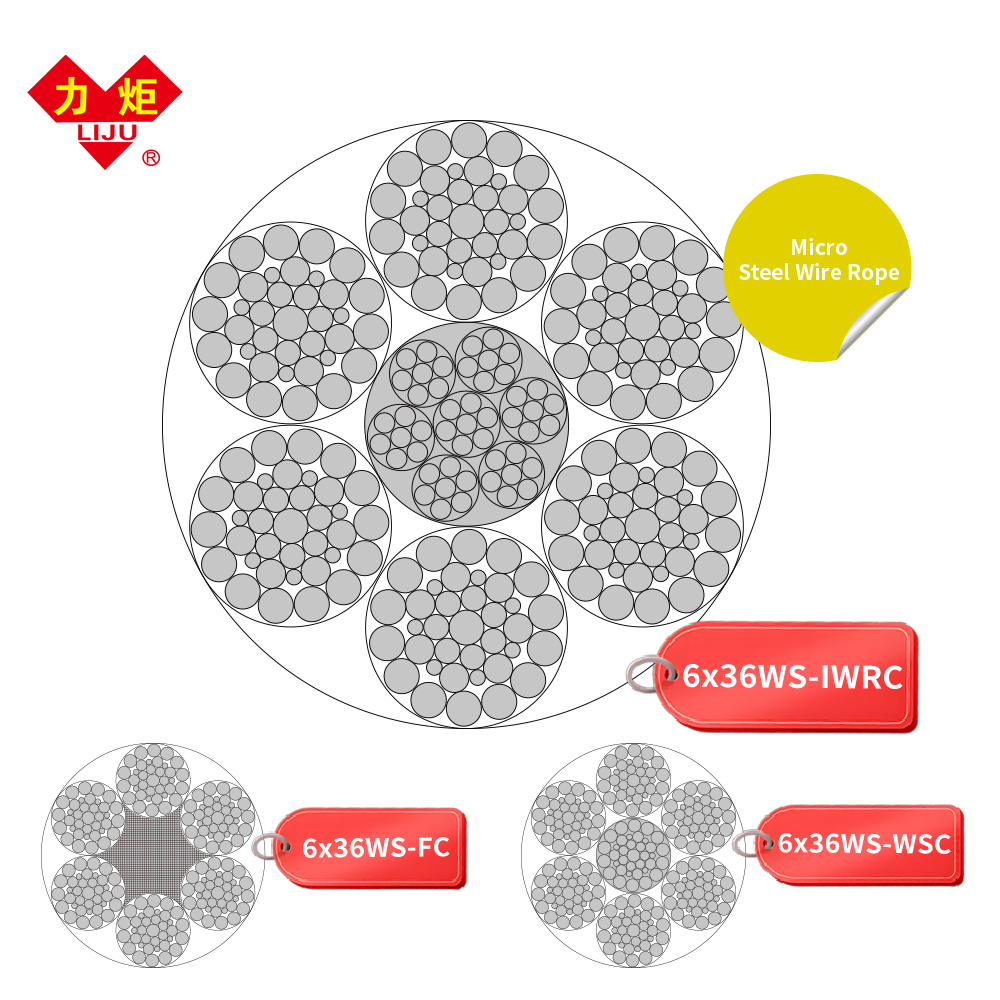
A construction designation is the identity that the mill, the standard and the certification body all use. This is why compliance cannot be separated from rope design.
- 6x19S sits in the elevator, mining and heavy-duty ranges and appears in both the CE list (6*19) and the ABS list (6x19S-IWRC). It is the most straightforward example of a construction where designation, core and scheme line up cleanly.
- 6x36WS is used where a better bend-to-strength balance is needed, and appears in the port, offshore and oil and gas ranges. It is named in the CE list (6*36) and in the ABS list (6x36WS-IWRC).
- 6xK36WS is a compacted variant. Compaction changes the rope, so the K designation has to be checked against the scheme listing rather than folded into a general 6x36 entry.
- 8x29Fi appears in the construction and engineering range model list. It is not named in the CE type list or the ABS model list, so a buyer specifying it for a regulated application should ask which document, if any, names it.
- 4Vx39S is a swaged triangular-strand construction listed in the offshore and marine range as 4Vx39S SWAGE. ABS names 4xV39FC-FC in its model list; CE does not name it.
- 35WxK7 appears across the port, mining and offshore ranges as 35W*7 or 35WxK7, and ABS lists 35(W)x7 and 35(W)xK7 among its covered models.
The pattern is consistent: two ropes that carry the same breaking load on paper can sit on opposite sides of a certificate scope. That is not a reason to avoid advanced constructions; it is a reason to write the designation, the core and the standard into the order and to check the document against them.
Step-by-step: verifying compliance before you commit to a purchase order
Step 1 — Write the duty, not only the diameter
Start from the operating condition: frequent bending in an elevator shaft, shock loading on a container crane, salt-spray exposure offshore, or light cyclic tension on a baler. The duty determines the construction, and the construction determines which certification scope is even relevant.
Step 2 — Fix the execution standard and its edition
State GB/T, EN, GOST or DIN explicitly, with the part and edition where one exists. Because the CE certificate cites EN 12385-1:2002+A1:2008 and the GOST certificate cites GOST 3241-91, EN 12385-4, GB/T 8918-2006 and GB/T 20118-2017, an unqualified instruction such as "to EN" leaves the acceptance criterion open to interpretation.
Step 3 — Read the certificate scope line by line
Check the construction designation, the core type, the surface condition and the diameter range. An IWRC rope is not interchangeable with an FC rope in the ABS model list, and a 6xK36WS is not automatically inside a 6*36 entry in a CE type list.
Step 4 — Check validity against your acceptance and delivery dates
Certificates have end dates, and they are not uniform: SIRIM PC013111 runs to 7 December 2026, SNI 0727:2008 to 3 July 2028, CCС JS22PWA00113_01 to 22 May 2027, API 9A-0125 to 28 February 2027, CE ICR/VC/HS240422 to 4 July 2029, GOST to 27 June 2029, ABS 24-0072296-PDA to 7 October 2029 and EPD-2026-01 to 29 January 2031. If acceptance testing falls after a scheme's expiry, confirm renewal status before the shipment leaves.
Step 5 — Agree the acceptance tests, not just the paperwork
Document review is only half of acceptance. The manufacturing quality controls behind this range include raw material incoming inspection, semi-finished product spot checks, finished product testing, breaking load testing and fatigue testing, plus a full machine running test on 100% of rope before delivery. Which of those you witness, and which reports travel with the order, should be agreed in the contract.
Step 6 — Put all of it into the purchase order and inspection plan
The order should carry the construction, core, diameter, tensile grade, surface treatment, execution standard, certification scheme required and the document set to be supplied. Marking, length tolerance and packing belong in the same document, because a compliant rope delivered in the wrong length or with unclear marking still fails acceptance.
Application use cases: how expectations diverge
Elevator wire rope
Elevator duty means high-frequency reciprocating bending in an enclosed shaft, with stable elongation as important as tensile strength. The elevator range covers 8x19S, 8x19W, 6x19S and 6x19W, available from 1 mm to 120 mm and 1570 to 2160 MPa, to GB/T, EN, GOST and DIN. The compliance detail buyers should check is that scheme lists differ: the CE type list names 6*19 and 8*19, while the ABS model list names 6x19S-IWRC but does not name an 8x19S. If your market requires a particular scheme, verify that the specific construction and core appear in it.

Mining hoisting ropes
Mine shaft hoisting combines heavy load cycles, humidity, abrasive dust and corrosive mine water, which is why the mining range spans 6x19S, 6x19W, 6x19M, 6x36WS, 6x37S, 8xK26WS-EPIWC and 35WxK7. The GOST certificate is the broadest document here, covering multiple construction types from 1 mm to 120 mm for the Russian market; even so, the exact construction and diameter should be confirmed inside that scope. A documented supply case from this manufacturer reports 100 tons of mining wire rope used for shaft hoisting and underground traction over a two-year period, with stable hoisting operation, reduced downtime and improved site safety — a manufacturer-reported outcome for one project, not a general performance guarantee.
Port container crane ropes
Port duty means coastal salt spray, high humidity, frequent shock loads and continuous cycling, and the range covers 6x26WS, 6x31WS, 6x36WS, 6x41WS, 8x26WS, 8x31WS, 8x36WS, 8x41WS and 35Wx7 for quay and gantry crane work, container handling, mooring and tug traction. For compliance, the useful starting points are the CE type list (6*36, 8*36 and 35W*7 are named) and SIRIM PC013111, which covers steel wire ropes for general purposes in Malaysia until 7 December 2026. Where a tender references an API specification, ask for the exact API document and scope rather than accepting a certificate number alone.
Offshore and marine ropes
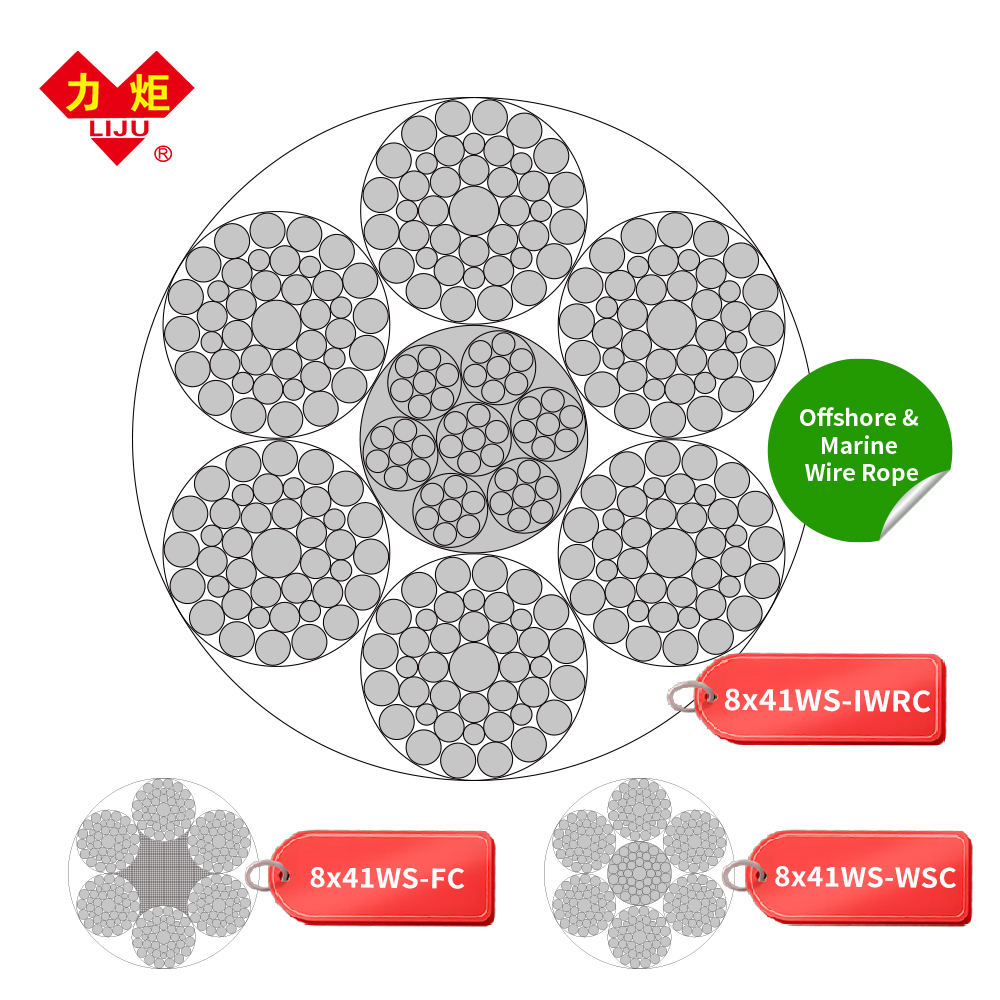
Offshore specification usually runs through classification society evidence rather than a single market mark. The offshore and marine range is the widest in the portfolio — 6x36WS, 6x29Fi, 6x41WS, 6x49SWS, 6x55SWS, 6x61FWS, 6x65FNS, 6x84WSNS, 6x127SWSNS and their 8-strand counterparts, plus 18x7, 35Wx7, 35WxK7 and the swaged 4Vx39S and 4Vx48S. CCS certificate JS22PWA00113_01, issued by CCS Jiangsu Branch, covers single layer ropes and rotation-resistant ropes for ships and offshore installations, which is why the construction category on the order has to match the category named in the certificate. ABS 24-0072296-PDA covers named models as loose gear for lifting equipment under ISO 2408-2017. Where a project requires environmental data, EPD-2026-01 provides a cradle-to-gate declaration per 1000 kg.

Agricultural and baler tying ropes
Agricultural duty is lighter but dirtier: mud, dust, rain and continuous low-tension cycling. The agricultural range covers 1x7, 1x19, 6x7, 7x7, 6x19M and the fibre-core 6x12-7FC, 6x15-7FC and 6x24MFC, with GB/T, EN, GOST and DIN named as execution standards. For baler tying and similar small-diameter farm duties, these are the designations to specify rather than a heavy-duty hoisting rope. The compliance check is again documentary: the CE type list names 6*7 and 6*19M, but does not name 1x7, 7x7, 6x12-7FC or 6x15-7FC, so buyers shipping those constructions into a regulated market should confirm which document the machine builder or importer actually requires.

Application comparison: what to verify before sourcing
| Application | Constructions in the range | Execution standards stated | Scheme evidence to verify |
|---|---|---|---|
| Elevator and escalator | 8x19S, 8x19W, 6x19S, 6x19W | GB/T, EN, GOST, DIN | CE names 6*19 and 8*19; ABS names 6x19S-IWRC but not 8x19S |
| Mining hoisting | 6x19S, 6x19W, 6x19M, 6x36WS, 6x37S, 8xK26WS-EPIWC, 35WxK7 | GB/T, EN, GOST, DIN | GOST covers multiple types from 1 mm to 120 mm; confirm the exact construction and diameter |
| Port container crane | 6x26WS, 6x31WS, 6x36WS, 6x41WS, 8x26WS, 8x31WS, 8x36WS, 8x41WS, 35Wx7 | GB/T, EN, GOST, DIN | CE names 6*36, 8*36 and 35W*7; SIRIM general purposes for Malaysia valid to 7 December 2026 |
| Offshore and marine | 6x36WS to 6x127SWSNS, 8-strand equivalents, 18x7, 35Wx7, 35WxK7, 4Vx39S and 4Vx48S SWAGE | GB/T, EN, GOST, DIN | CCS for single layer and rotation-resistant ropes on ships and offshore installations; ABS loose gear list with core designations |
| Agricultural, including baler tying | 1x7, 1x19, 6x7, 7x7, 6x19M, 6x12-7FC, 6x15-7FC, 6x24MFC | GB/T, EN, GOST, DIN | CE names 6*7 and 6*19M; 1x7, 7x7, 6x12-7FC and 6x15-7FC are not named |
Read the table as a checklist, not a ranking. The right column tells you what to request in writing; it does not tell you which application is more strictly regulated, because that answer depends on the jurisdiction and the machine into which the rope is built.
Frequently asked questions
Does one CE certificate cover every steel wire rope construction in a range?
No. The CE certificate ICR/VC/HS240422, issued by ICR under EN 12385-1:2002+A1:2008, names the types it covers: 6*7, 8*7, 6*19, 8*19, 6*36, 8*36, 6*19M, 6*37M, 18*7, 34M*7 and 35W*7, for the EU market. Constructions outside that list — for example a swaged 4Vx39S or a compacted 6xK36WS — require their own scope confirmation. Always compare the designation on your order with the designation in the certificate.
Can a supplier manufacture to GB/T, EN, GOST and DIN within one order programme?
Yes, where the manufacturer states those four as applicable execution standards. In this range the customization scope covers rope construction, diameter, length, tensile strength, surface treatment, applicable standard and packing, under OEM, ODM or own-factory R&D and manufacturing, with a stated monthly capacity of 3000 tons. Quality control includes raw material incoming inspection, semi-finished product spot checks, finished product testing, breaking load testing, fatigue testing and a full machine running test on 100% of rope before delivery.
What drives the cost of a compliant steel wire rope?
Compliance documents are not the main cost driver; the rope is. The variables that move cost are the construction (a 6x19S, a compacted 6xK36WS and a swaged 4Vx39S involve different processing), the tensile grade selected from the 1570 to 2160 MPa range, the core type, the surface treatment, the diameter-to-length combination, the testing and documentation package required, and how order quantity compares with the stated minimum order of 1000 meters. Two quotes at the same price can differ in grade, core or documentation, so compare the specification line by line before comparing the number.
What should a pre-order sample evaluation include?
Ask for a sample in the exact construction, core, tensile grade and surface condition you intend to buy, made to the same execution standard as the production order. Check the marking, measured diameter and length, and request the breaking load and fatigue test results that accompany the quality-control sequence. Confirm in writing that the certification scope you rely on names that construction and core; a sample that performs well but falls outside the scope creates an acceptance problem later, not a technical one.
What are the stated minimum order and lead time, and how does certification affect delivery?
The stated minimum order is 1000 meters and the stated production lead time is 25 days; confirmation against your specific construction, testing package and documents should come with the quotation. Certification affects timing through validity dates rather than manufacturing: SIRIM PC013111 currently runs to 7 December 2026, while API 9A-0125, CCS JS22PWA00113_01, SNI 0727:2008, GOST POCC RU C-CN.AД85.B.00499/24, CE ICR/VC/HS240422, ABS 24-0072296-PDA and EPD-2026-01 run to later dates. If acceptance falls near a scheme expiry, ask for renewal evidence with the quotation. For a specification review or a documented sample request, the company product brochure summarises the ranges and construction options.
Conclusion: align the purchase terms with the standard, not with the brochure
Compliance for steel wire rope is resolved application by application. An elevator rope, a mine hoist rope, a container crane rope, an offshore mooring rope and a baler tying rope are all steel wire rope, made from high carbon steel between 1 mm and 120 mm in grades from 1570 to 2160 MPa, and all can be manufactured to GB/T, EN, GOST and DIN — but they are accepted by different documents, for different reasons, on different dates.
The practical conclusion is procedural. Name the construction and core in the purchase order, name the execution standard with its edition, name the scheme your market or classification society requires, and require the certificate scope line to match all three. Then check the certificate's validity against your acceptance date, and agree the test package — breaking load, fatigue, and the running test on the finished rope — before the order is placed. Buyers who follow that sequence spend their time on engineering questions rather than on documentation disputes after delivery.
Next step: if you are matching a construction to a specific standard or market scheme, send the duty, diameter, tensile grade and destination market for a documented review of the applicable scope and acceptance criteria.
Jiangsu Juli Steel Wire Rope Co.,LTD · www.juli-rope.com · Download the product brochure
Have Questions or Need More Details?
Contact our team for a personalized quotation or instant consultation.
Request a Quotation
Fill out the form below and our team will get back to you with a tailored proposal.
WhatsApp Direct Chat
Prefer to chat in real-time? Message us on WhatsApp for instant assistance & quick answers.
- Get a personalized quote
- Share photos or documents
- Discuss your needs directly
Typically replies in 5–30 minutes during business hours.