Construction & Engineering Wire Rope: 6x19S, 6x36WS & 8x29Fi
Construction & Engineering Wire Rope: A Technical Selection Guide for Structural Projects
Construction and engineering wire rope is selected in five steps: strand construction, diameter, tensile grade, corrosion protection, and the standard the rope must be certified to. For structural projects, three constructions carry most of the duty — 6x19S for abrasion-dominant tensioning and static work, 6x36WS where the rope runs over sheaves and spools in multiple layers, and 8x29Fi where an eight-strand rope is specified. All three are listed in the Construction & Engineer wire rope range of Jiangsu Juli Steel Wire Rope Co.,LTD, which covers rope diameters from 1 mm to 120 mm, tensile grades from 1570 to 2160, and applicable execution standards including GB/T, EN, GOST and DIN.
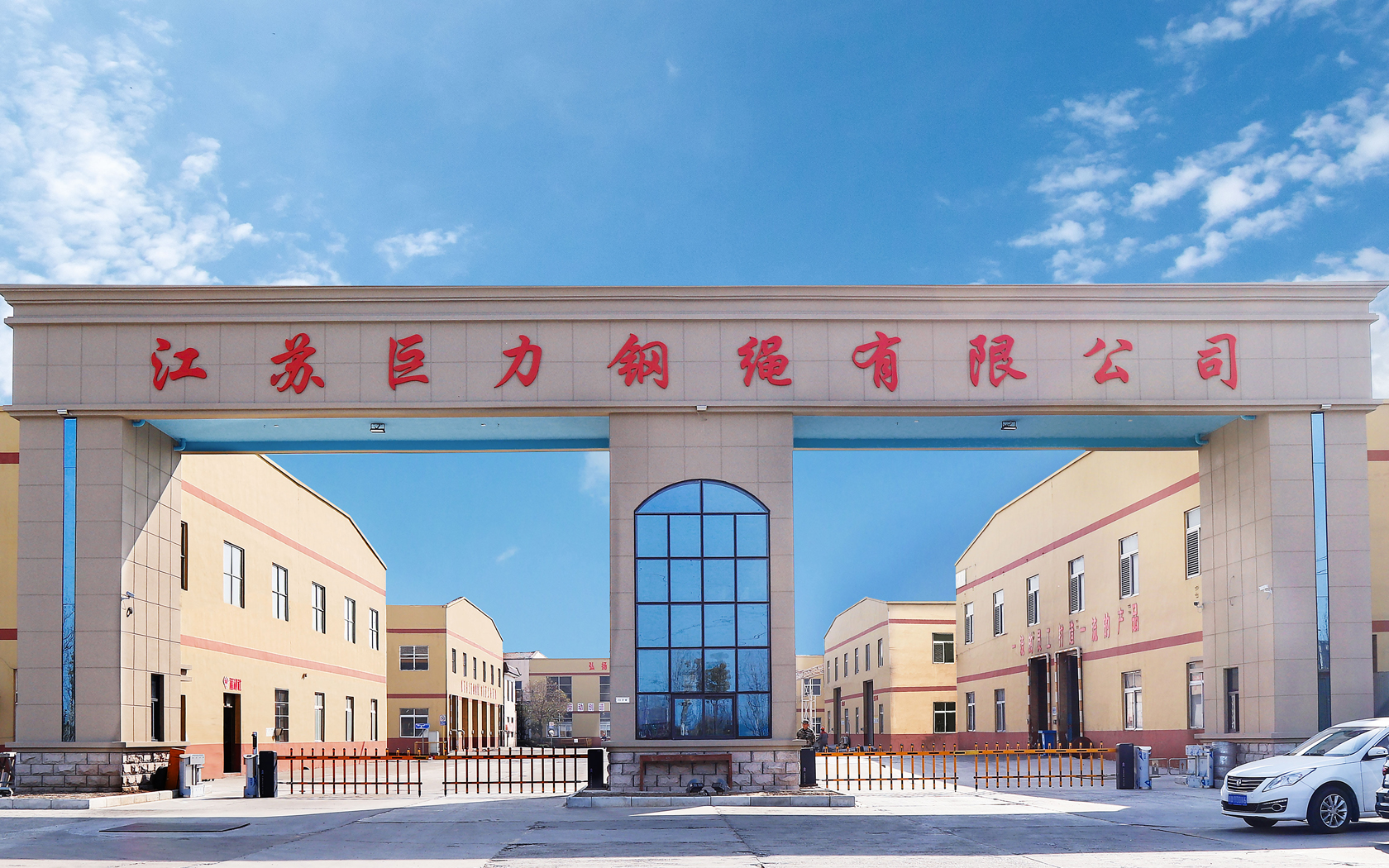
Jiangsu Juli Steel Wire Rope Co.,LTD (Juli Steel Rope) is a manufacturer of steel wire rope and wire rope slings with three production bases worldwide: Nantong and Jiyuan in China, and Bekasi in Indonesia. The company's origins date back to 1958, and Jiangsu Juli Steel Wire Rope Co.,LTD was founded in 1995. Its product range spans un-galvanized, electro-galvanized, hot-dip galvanized, stainless and plastic-coated wire ropes, in constructions that include cross laid, parallel laid, anti-rotation, compacted strand, shaped strand and locked coil ropes. The company holds certifications including API, LR, ABS, CCS, ISO9001, CE, GOST, EPD, SIRIM, SNI and MA.
Problem Definition: What a Structural Rope Actually Has to Survive
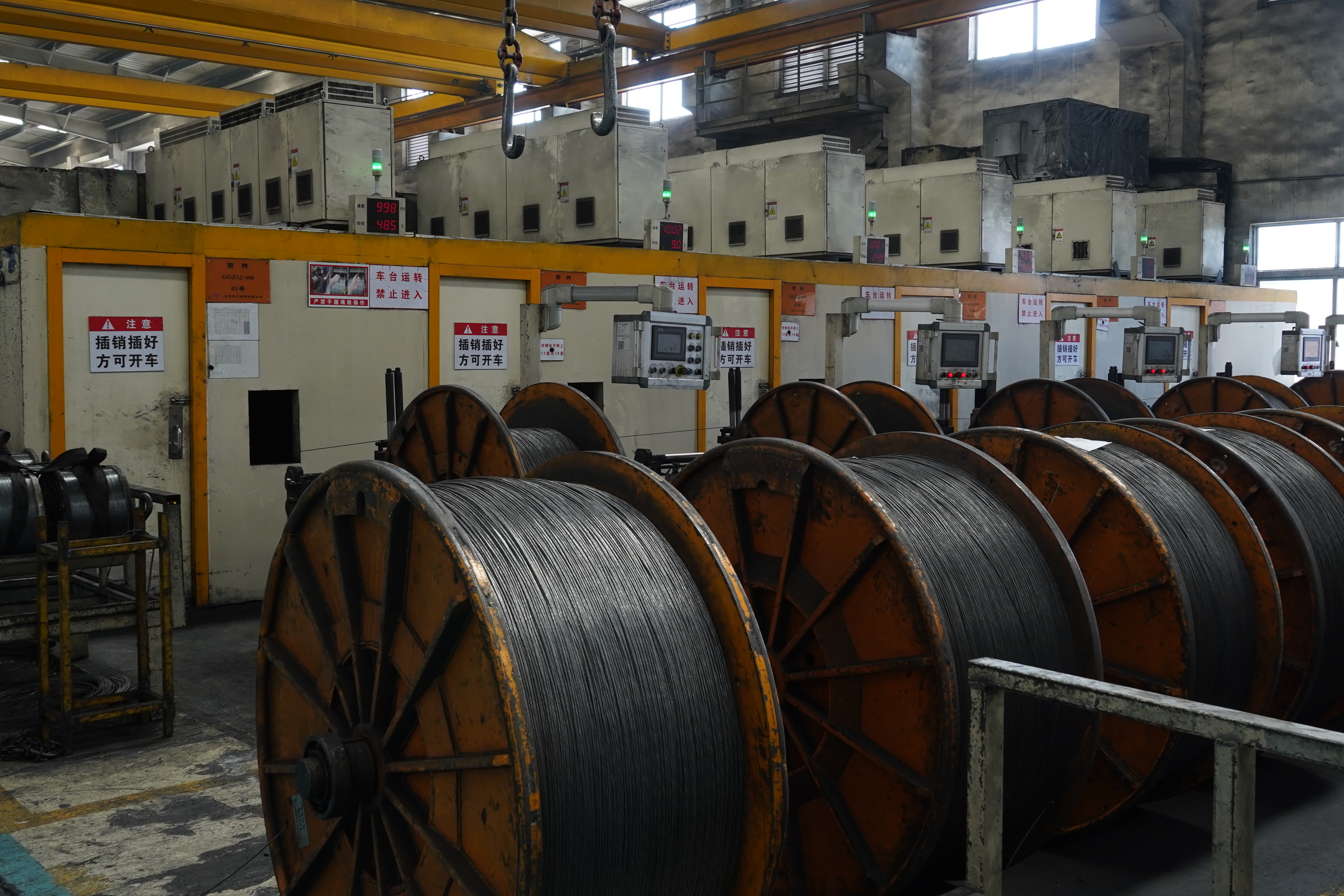
Wire rope on a structural project usually has one of two jobs, and those two jobs pull the specification in opposite directions.
- Tension and static duty — guy lines, tie-backs, bracing, holding and tensioning arrangements. Bending cycles are few, so abrasion against drums, saddles, guides and abrasive ground becomes the dominant wear mechanism.
- Running duty — hoist lines, trolley lines, winch drums and multi-layer spooling on cranes and construction machinery. The rope bends and straightens repeatedly, so fatigue at the bend becomes the limiting factor.
Because of that split, most specification errors are not about diameter. They come from four mismatches:
- Construction versus sheave and drum geometry. A stiff rope running over small sheaves or spooling in multiple layers can fail at the bend long before it approaches its nominal breaking force.
- Fatigue versus abrasion balance. In general industry practice, ropes with more, finer outer wires resist bending fatigue better, while ropes with fewer, larger outer wires resist abrasion better. Every structural project has to decide which of the two it is buying.
- Corrosion exposure. Coastal air, tunnelling water, dust and chemical exposure decide whether an un-galvanized rope is acceptable or a galvanized, stainless or plastic-coated rope is required.
- Documentation and standard mismatch. A rope that is dimensionally correct but documented to the wrong standard can stop at the port. Compliance has to be settled at the specification stage, not at delivery.
On top of the technical decision, the execution stage adds commercial constraints — minimum order quantity, lead time, acceptance testing and payment terms — that should be planned together with the rope specification rather than after it.
Industry Background: Why Selection Discipline Matters More Now
Demand for steel wire rope is growing steadily, and construction remains the largest single demand centre.
- The global steel wire rope market was estimated at USD 10.49 billion in 2025 and is projected to reach USD 13.88 billion by 2030, a CAGR of 5.8% (MarketsandMarkets).
- Construction is the largest end-user segment, accounting for approximately 27% to 40.7% of total market share in 2024–2025 (Grand View Research / industry research).
- Galvanized wire rope accounted for 41.3% to 46% of global product demand in 2025, driven by corrosion-resistance requirements in marine and mining environments (Dataintelo / Business Research Insights).
- China was the largest exporter of stranded wire, ropes and cables of iron or steel in 2024, with an export value of approximately USD 2.60 billion (World Integrated Trade Solution, WITS).
- ISO 2408:2017 specifies the minimum requirements for the manufacture and testing of steel wire rope for general purposes, including lifting and rigging (International Organization for Standardization).
Two product trends sit behind those numbers. The first is corrosion protection: when roughly two out of every five metres of rope sold worldwide are galvanized, an un-galvanized specification on an exposed structural site needs justification. The second is compacted and shaped strand design. Mining operations, for example, adopted compacted strand ropes in approximately 57% of heavy-duty hauling systems globally in 2025 (Business Research Insights) — the same logic that pushes structural and civil contractors toward compacted strand ropes when sheave geometry is fixed and breaking force has to rise without increasing diameter. Compacted strand and shaped strand ropes are both listed in the Juli Steel Rope product range.
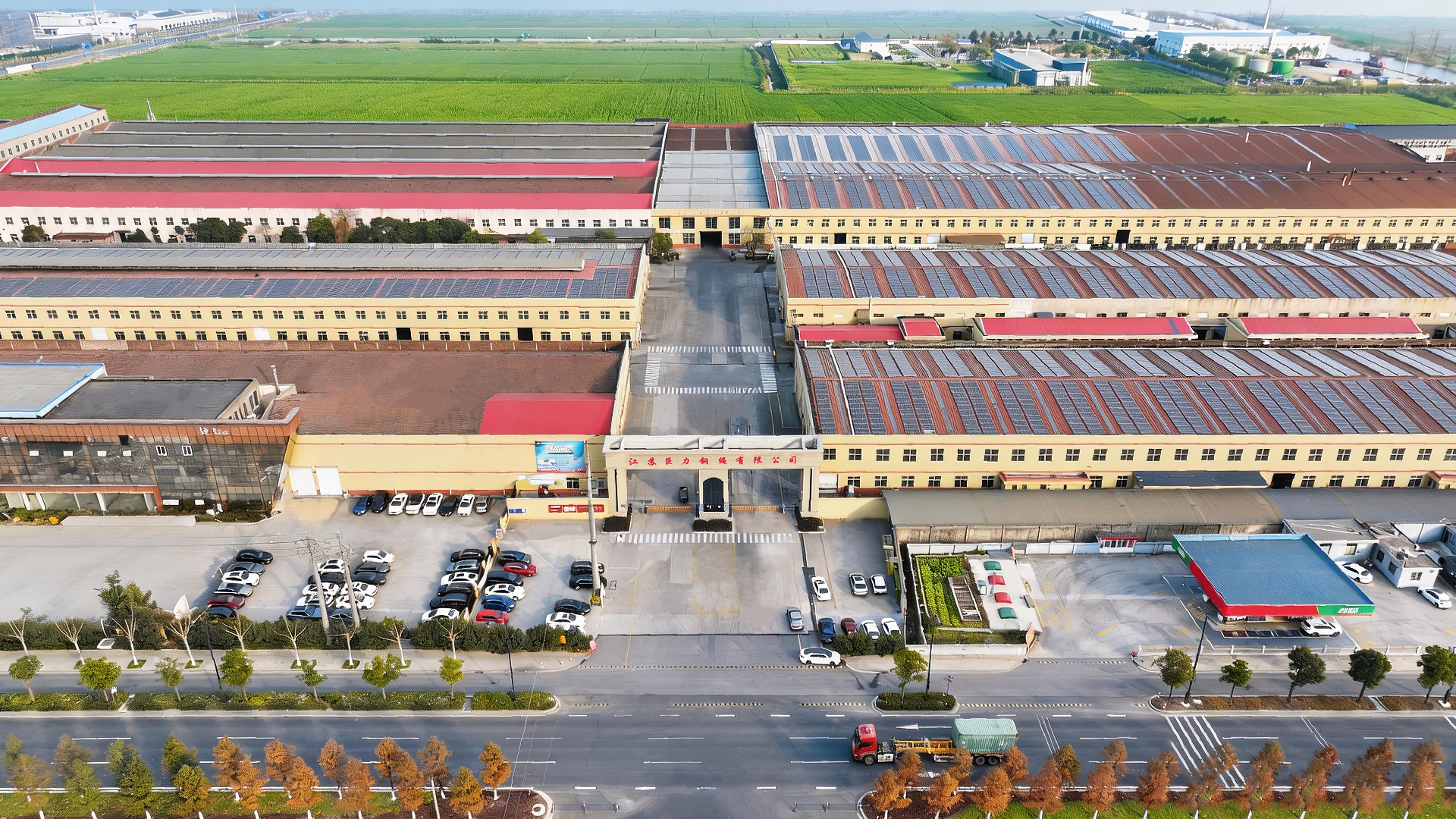
On the supply side, the market remains a mix of global groups and regional specialists. Bekaert (Belgium) and WireCo WorldGroup (US) are identified as the two companies with the highest global market share, with Bekaert exceeding 1.5 million tons of annual capacity (industry research / MarketsandMarkets). Juli Wire Rope Group operates three production bases — Nantong and Jiyuan in China and Bekasi in Indonesia — covering an area of 350,000 square meters, with total assets of USD 150 million and an annual steel wire rope production capacity of 250,000 tons. Its rope range runs from 0.5 mm to 120 mm, and the group maintains 42 distribution centres in major Chinese cities including Shanghai, Guangzhou, Chengdu and Xi'an, plus offices in more than 30 countries and regions.
Detailed Solution: Matching Strand Construction to Machine Duty
The Construction & Engineer wire rope range lists the following constructions: 6x19S, 6x19W, 6x29Fi, 6x36WS, 8x29Fi, 6xK36WS, 18x7, 35Wx7, 35WxK7, 4Vx39S, 8x19S, 4x26WS, 4x31WS, 6x19M, 6x37M, 6x12-7FC and 6x15-7FC. All are manufactured from high carbon steel in diameters from 1 mm to 120 mm, at tensile grades of 1570, 1670, 1770, 1870, 1960 or 2160, to applicable execution standards GB/T, EN, GOST or DIN.
Three of those constructions decide most structural specifications. The table further down compares them directly; the sections below explain what each one is for.
6x19S: Abrasion-Led Duty and Straight-Line Tension
6x19S is a six-strand, 19-wire-per-strand rope in a Seale (S) strand design, meaning the outer wires of each strand are comparatively large. That geometry trades bending flexibility for wear resistance: the rope is generally stiffer and less tolerant of small sheaves, but holds up well where the duty is dominated by abrasion and static tension rather than repeated bending.
Typical structural uses are tensioning and holding lines, bracing, static guy arrangements, and hoisting where the sheave-to-rope diameter ratio is generous. Within the Juli range, 6x19S appears not only in the Construction & Engineer range but also in the Heavy-Duty, Mining, Oil & Gas, Fishing, Logging Forestry, Cable Car, Elevator and Micro ranges, which is one reason it appears in so many structural procurement plans.
6x36WS: Running Ropes, Small Sheaves and Multi-Layer Spooling
6x36WS is a six-strand, 36-wire-per-strand rope in a Warrington-Seale (WS) strand design. The higher wire count per strand produces a more flexible rope that generally tolerates repeated bending and reverse bending better than a 6x19-class rope of the same diameter. That is why it dominates hoist lines, trolley lines and winch drums on cranes and construction machinery.
Typical structural uses are crane hoist and trolley lines, multi-layer winch drums where the rope crosses over itself under load, and machinery where sheave or drum diameter cannot be enlarged. It appears in the Construction & Engineer and Construction Machinery ranges, as well as the Heavy-Duty, Mining, Port, Oil & Gas, Offshore & Marine, Cable Car, Fishing and Micro ranges. Compacted variants such as 6xK36WS are available where the same construction has to deliver more breaking force at the same diameter.
8x29Fi: Eight-Strand Configurations for Specified Duty
8x29Fi is an eight-strand rope with 29 wires per strand in a filler-wire (Fi) design, and it is listed specifically in the Construction & Engineer wire rope range. It is normally specified where the machine builder, the structural engineer or the local standard calls for an eight-strand rope, or where the strand count has to rise within a fixed diameter.
Where rotation resistance is the real requirement — single-part hoisting of a free load, or long free-hanging lines — the same range offers 18x7, 35Wx7, 35WxK7 and 4Vx39S constructions, plus compacted 6xK36WS. Where the rope must run on a curved or irregular path, the group also manufactures parallel laid and locked coil constructions.
High Carbon Steel, Diameter and Tensile Grade
Two parameters are fixed by the machine rather than by preference. Diameter is set by drum and sheave geometry and by the required breaking force. Tensile grade is set by the load case and by the working coefficient required in the project specification.
- Material: high carbon steel across the Construction & Engineer range.
- Diameter range: 1 mm to 120 mm for construction and engineering ropes; 0.5 mm to 120 mm across the group's full product range.
- Tensile grades available: 1570, 1670, 1770, 1870, 1960 and 2160.
- Applicable execution standards: GB/T, EN, GOST, DIN. The company also states that it manufactures according to API, ISO, EN, ASTM, GB and JIS standards.
In general industry practice, moving to a higher tensile grade increases the breaking force available at the same diameter, which is useful when machine geometry cannot change. The trade-off is that rope-to-sheave geometry, drum diameter and the number of bending cycles should be reviewed together with the grade, because in running duty the limiting factor is usually fatigue at the bend rather than the nominal breaking force.
Corrosion Resistance and Surface Treatment
Surface treatment is one of the six parameters that can be customized on an OEM order, alongside construction, diameter, length, tensile strength, applicable standard and packing. The group manufactures un-galvanized, electro-galvanized, hot-dip galvanized, stainless and plastic-coated wire rope.
For structural projects, the choice normally follows the exposure class. Un-galvanized rope suits dry, sheltered and short-service applications. Electro-galvanized and hot-dip galvanized ropes suit general outdoor and coastal site work; hot-dip galvanizing is the usual selection where the zinc layer has to survive handling and abrasion as well as atmosphere. Stainless rope is used where corrosion resistance rather than breaking force governs the specification, and plastic-coated rope where the rope contacts sensitive surfaces or needs an additional mechanical barrier. The market data supports the direction: galvanized ropes accounted for 41.3% to 46% of global demand in 2025 on corrosion-resistance grounds alone (Dataintelo / Business Research Insights).
Standards and Documentation: GB/T, EN, GOST and DIN
Construction and engineering ropes in the Juli range are manufactured to applicable execution standards GB/T, EN, GOST or DIN. For a structural project, what matters is not the list of standards a manufacturer mentions, but which certificate covers the exact construction, diameter and destination market in question.
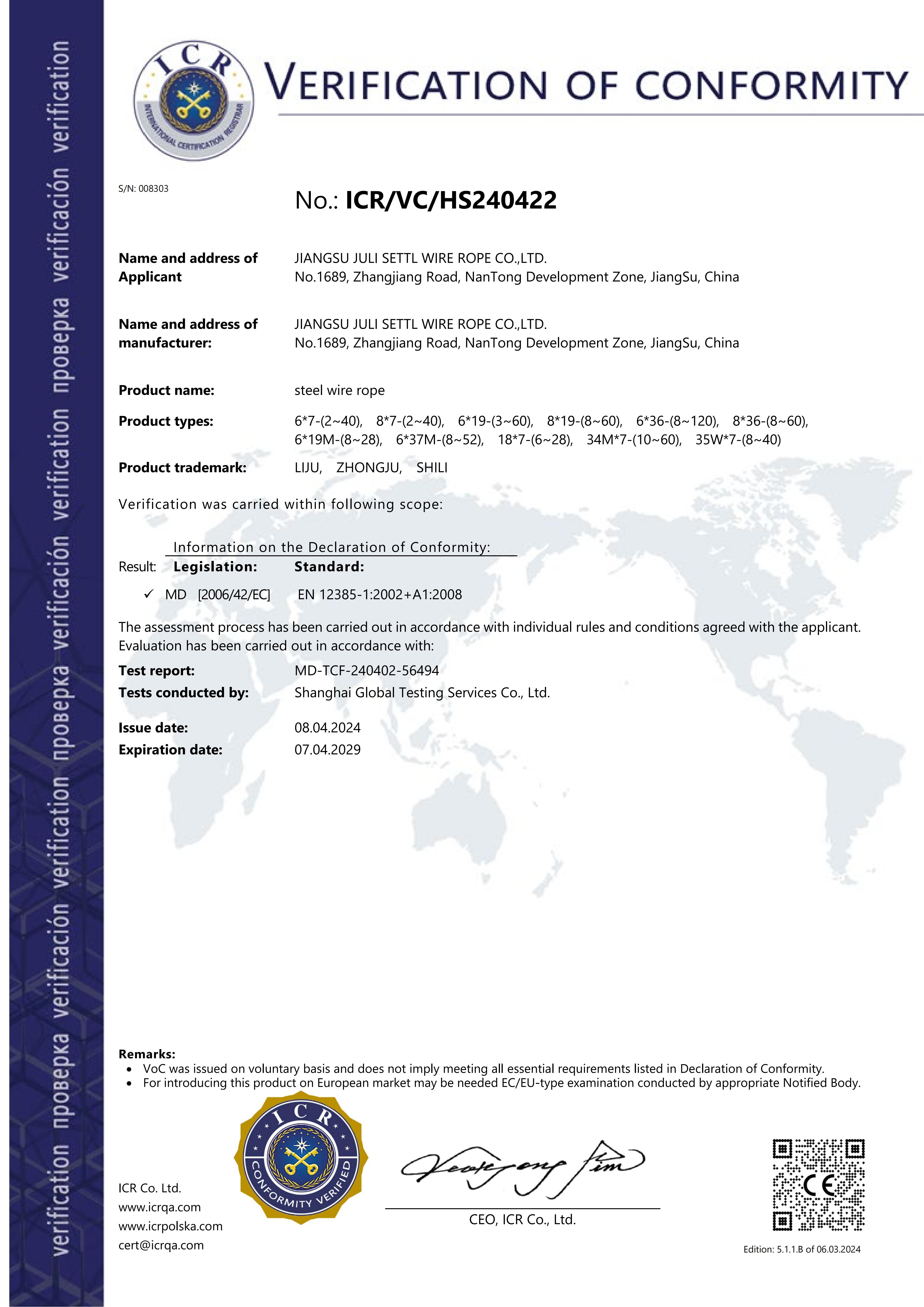
- CE — ICR/VC/HS240422. Issued to EN 12385-1:2002+A1:2008 for the EU market, valid from 2024-08-04 to 2029-07-04. The certificate scope covers rope types 6x7, 8x7, 6x19, 8x19, 6x36, 8x36, 6x19M, 6x37M, 18x7, 34Mx7 and 35Wx7, with diameter ranges listed per type, for example 6x19 at 3–60 mm and 6x36 at 8–120 mm.
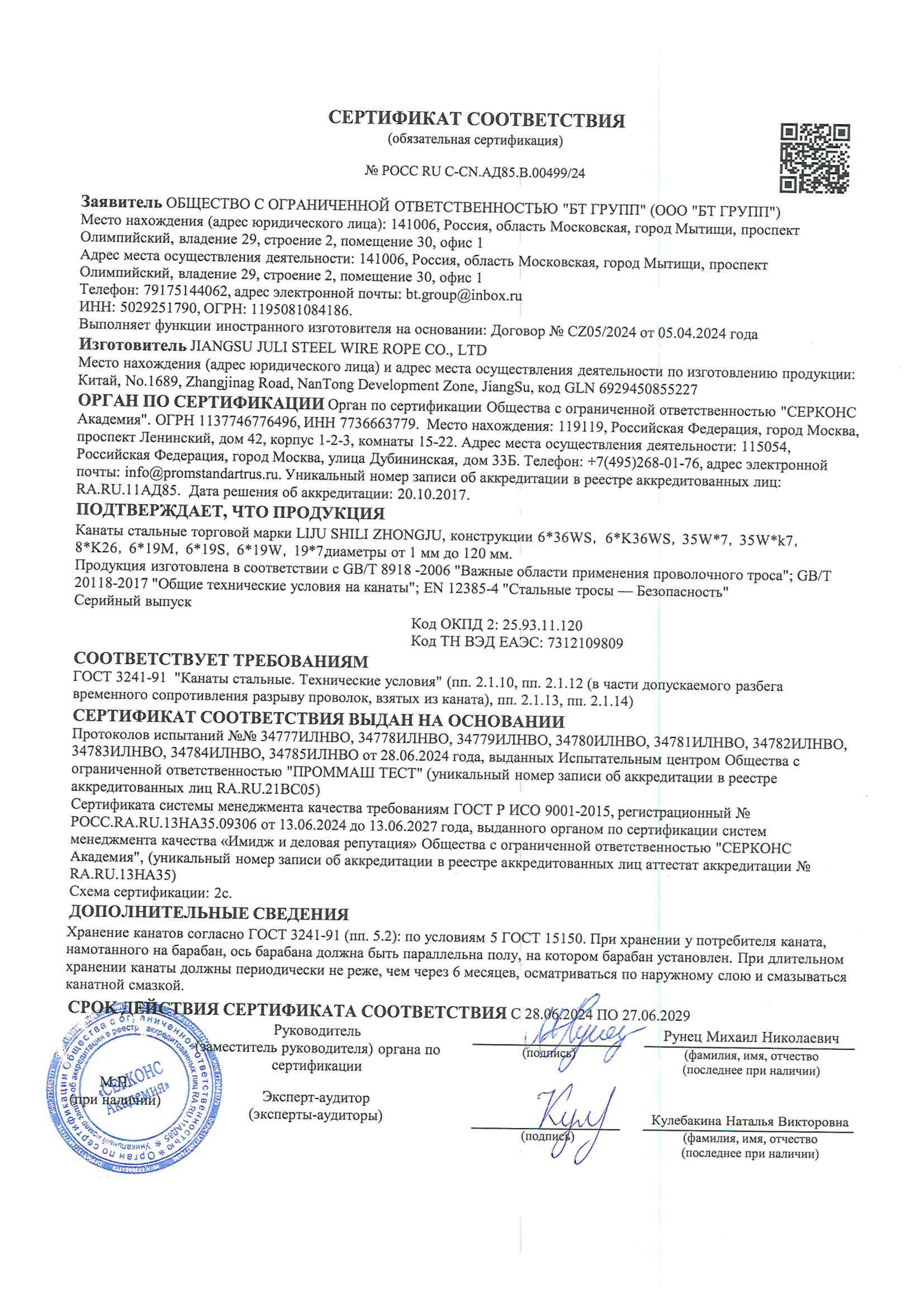
- GOST — POCC RU C-CN.AД85.B.00499/24. Issued for the Russian market, valid from 2024-06-28 to 2029-06-27, covering steel wire rope of multiple construction types from 1 mm to 120 mm against GOST 3241-91, GB/T 8918-2006, GB/T 20118-2017 and EN 12385-4.
- ABS — 24-0072296-PDA. Issued by the American Bureau of Shipping to ISO 2408-2017 for loose gear items used on lifting equipment, valid from 2024-10-08 to 2029-10-07. Approved models include 6x19S-IWRC, 6x36WS-IWRC, 18x7-WSC, 35(W)x7 and 35(W)xK7.
- Market-specific documents. API 9A-0125 to API Spec Q1 / API-9A (valid to 2027-02-28), CCS JS22PWA00113_01 for ships and offshore installations (valid to 2027-05-22), SIRIM PC013111 to MS ISO 2408:2004 for Malaysia (valid to 2026-12-07), SNI to SNI 0727:2008 for petroleum and natural gas in Indonesia (valid to 2028-07-03), and EPD-2026-01 to ISO 14025 (valid to 2031-01-29).
Step-by-Step: Selecting Construction and Engineering Wire Rope
- Define the duty. Static or running. If static, the driver is abrasion plus tension. If running, the driver is fatigue, and the number of bending cycles, sheave diameter, drum diameter, number of spooling layers and fleet angle all become specification inputs.
- Fix diameter and tensile grade. Work from machine geometry first, then from the required breaking force. Available range: 1–120 mm, with grades from 1570 to 2160.
- Select the strand construction. Use 6x19S where abrasion dominates and bending is limited; 6x36WS where the rope runs, bends and spools in multiple layers; 8x29Fi or another eight-strand, compacted or rotation-resistant construction where the machine or the standard requires it.
- Confirm the core and lay configuration. Core designations appear directly in the model codes — IWRC, FC and WSC cores are named in the ABS certificate models, and 8xK26WS-EPIWC is a compacted mining construction with an EPIWC core. Confirm the core with the manufacturer rather than inferring it from diameter alone.
- Choose corrosion protection. Match the surface treatment — un-galvanized, electro-galvanized, hot-dip galvanized, stainless or plastic-coated — to the exposure class of the site.
- Lock the standard and the certificate. Set GB/T, EN, GOST or DIN as the execution standard, then confirm the specific certificate the destination market requires: CE, GOST, ABS, CCS, API, SIRIM, SNI or EPD.
- Validate by test before shipment. Write the quality-control route into the purchase order: raw material incoming inspection, semi-finished product spot check, finished product test, breaking load test, fatigue test, and a 100% full machine running test before delivery, with test reports issued for customer confirmation before shipment.
- Plan the commercial terms with the technical specification. Minimum order quantity 1000 metres, delivery terms FOB / CIF / DDP, and payment terms of 30% deposit with the 70% balance before shipment.
Planning note: With a quoted lead time of 25 days against a monthly production capacity of 3,000 tons, structural projects that need rope staged across several site phases should confirm the delivery schedule at the specification stage rather than after the purchase order is placed.
Comparison Table: 6x19S vs 6x36WS vs 8x29Fi
| Selection factor | 6x19S | 6x36WS | 8x29Fi |
|---|---|---|---|
| Strand design | 6 strands, 19 wires per strand, Seale | 6 strands, 36 wires per strand, Warrington-Seale | 8 strands, 29 wires per strand, filler wire (Fi) |
| General behaviour | Fewer, larger outer wires; typically stiffer, more abrasion-tolerant, less tolerant of small sheaves | More, finer outer wires; typically more flexible and better suited to repeated bending | Eight-strand layout; specified where strand count or the project standard requires an eight-strand rope |
| Listed in the Construction & Engineer range | Yes | Yes | Yes |
| Also listed in other Juli ranges | Heavy-Duty, Mining, Oil & Gas, Fishing, Logging Forestry, Cable Car, Elevator, Micro | Construction Machinery, Heavy-Duty, Mining, Port, Oil & Gas, Offshore & Marine, Cable Car, Fishing, Micro | Not listed in the other published ranges in this data set |
| Compacted variant available | Not listed in this range | 6xK36WS | Not listed in this range |
| Typical structural role | Tensioning, holding, bracing, static hoisting | Crane hoist and trolley lines, winch drums, multi-layer spooling | Eight-strand specifications set by the machine builder or project standard |
| Tensile grades | 1570–2160 | 1570–2160 | 1570–2160 |
| Execution standards | GB/T, EN, GOST, DIN | GB/T, EN, GOST, DIN | GB/T, EN, GOST, DIN |
Both 6x19S and 6x36WS are also named in the ABS certificate model list (6x19S-IWRC and 6x36WS-IWRC), and both fall inside the diameter bands covered by the CE certificate for their type.
Certification Reference for Structural Projects
| Certificate | Scope relevant to construction and engineering rope | Referenced standard | Market | Valid to |
|---|---|---|---|---|
| CE (ICR/VC/HS240422) | Rope types 6x7, 8x7, 6x19, 8x19, 6x36, 8x36, 6x19M, 6x37M, 18x7, 34Mx7, 35Wx7, with per-type diameter ranges | EN 12385-1:2002+A1:2008 | EU | 2029-07-04 |
| GOST (POCC RU C-CN.AД85.B.00499/24) | Steel wire rope, multiple construction types, 1–120 mm | GOST 3241-91; GB/T 8918-2006; GB/T 20118-2017; EN 12385-4 | RU | 2029-06-27 |
| ABS (24-0072296-PDA) | Loose gear items for lifting equipment; models include 6x19S-IWRC, 6x36WS-IWRC, 18x7-WSC, 35(W)x7, 35(W)xK7 | ISO 2408-2017 | Global | 2029-10-07 |
| API (9A-0125) | Bright or drawn-galvanized wire rope | API Spec Q1, API-9A | Global | 2027-02-28 |
| CCS (JS22PWA00113_01) | Single layer ropes and rotation resistant ropes for ships and offshore installations | CCS Rules for Materials and Welding 2022, Chapter 10, Part One | Global | 2027-05-22 |
| SIRIM (PC013111) | Steel wire ropes for general purposes | MS ISO 2408:2004 | Malaysia | 2026-12-07 |
| SNI | Steel wire rope for petroleum and natural gas | SNI 0727:2008 | Indonesia | 2028-07-03 |
| EPD (EPD-2026-01) | Wire rope, 1000 kg, cradle-to-gate | ISO 14025 | Global | 2031-01-29 |
Use Cases: Where Each Construction Goes
- Structural tensioning and holding: 6x19S, where abrasion resistance matters more than bending flexibility.
- Crane and construction machinery lines: the Construction Machinery Wire Rope range lists 6x25Fi, 6x29Fi, 6x36WS, 6xK36WS, 18x7, 35Wx7, 35WxK7 and 4Vx39S.
- Heavy-duty lifting, hoisting, metallurgy and heavy industry: the Heavy-Duty range lists 6x19S, 6x19W, 6x26WS, 6x36WS, 6x31WS, 8xK26WS, 6x19M and 6x37M.
- Port and terminal handling: the Port range lists 6x26WS, 6x31WS, 6x36WS, 6x41WS, 8x26WS, 8x31WS, 8x36WS, 8x41WS and 35Wx7.
- Long free-hanging or single-part lifting: rotation-resistant options 18x7, 35Wx7, 35WxK7 and 4Vx39S, plus the swaged 4Vx39S and 4Vx48S offshore variants.
A documented supply case shows what severe-duty rope has to deliver over time. A mining enterprise ordered 100 tons of mining wire rope for hoisting, mine shaft lifting and underground traction, across constructions 6x19S, 6x19W, 6x19M, 6x36WS, 6x37S, 8xK26WS-EPIWC and 35WxK7. Across a two-year supply relationship, the reported outcome was stable hoisting operation, reduced downtime and improved site-work safety, with the rope selected for high wear resistance, strong impact resistance and a long service cycle in a harsh environment. The same durability logic — abrasion resistance under continuous load — is what structural and civil projects are buying when they specify 6x19S or a Heavy-Duty range rope.

FAQ
1. Which standards and certifications cover construction and engineering wire rope?
Construction and engineering ropes in the Juli range are produced to applicable execution standards GB/T, EN, GOST or DIN, and the manufacturer also states that it manufactures according to API, ISO, EN, ASTM, GB and JIS standards. Documented third-party certification includes CE certificate ICR/VC/HS240422 to EN 12385-1:2002+A1:2008 (EU, valid to 2029-07-04), GOST certificate POCC RU C-CN.AД85.B.00499/24 covering steel wire rope of multiple construction types from 1 mm to 120 mm (RU, valid to 2029-06-27), ABS certificate 24-0072296-PDA to ISO 2408-2017 for loose gear items on lifting equipment (valid to 2029-10-07), API 9A-0125 (valid to 2027-02-28), CCS JS22PWA00113_01 (valid to 2027-05-22), SIRIM PC013111 (valid to 2026-12-07), SNI to SNI 0727:2008 (valid to 2028-07-03) and EPD-2026-01 to ISO 14025 (valid to 2031-01-29).
2. Can an OEM multi strand steel wire rope manufacturer customize the construction for a specific project?
Yes. Jiangsu Juli Steel Wire Rope Co.,LTD offers OEM, ODM and independent factory R&D and manufacturing services, with customization of wire rope construction, diameter, length, tensile strength, surface treatment, applicable standard and packing. The multi-strand constructions available for this kind of customization include 6x19S, 6x29Fi, 6x36WS, 8x29Fi, 6xK36WS, 18x7, 35Wx7, 35WxK7 and 4Vx39S within the Construction & Engineer range, manufactured from high carbon steel in diameters of 1 mm to 120 mm and tensile grades of 1570 to 2160.
3. What are the purchasing terms and acceptance criteria?
Minimum order quantity is 1000 metres. Delivery terms are FOB, CIF or DDP. Acceptance criteria are a pre-shipment full performance test at the factory, with test reports provided for customer confirmation before shipment. Payment terms are 30% deposit and 70% balance payment before shipment, with shipment arranged only after receipt of full payment.
4. How is rope quality validated before a full order is released?
The quality-control route covers raw material incoming inspection, semi-finished product spot check, finished product test, breaking load test and fatigue test, plus a 100% full machine running test before delivery. For a first order or a new construction, the buyer can fix construction, diameter, length, tensile strength, surface treatment and applicable standard in the specification and confirm the result against the pre-shipment test report before the balance payment is released.
5. What is the lead time, and what support is available after delivery?
Quoted lead time is 25 days, against a monthly production capacity of 3,000 tons. After delivery, support includes remote online technical support, overseas engineer on-site service, regular operation guidance and maintenance consultation. Orders are dispatched from 42 distribution centres in major Chinese cities including Shanghai, Guangzhou, Chengdu and Xi'an, with offices in more than 30 countries and regions including Europe, the United States, Indonesia, the United Arab Emirates, Egypt, Russia and Brazil. To start a specification review or request a quotation, contact Shirley at Shirley@worldjuli.com or download the product catalogue below.
Conclusion: The Selection Checklist for Structural Projects
Structural wire rope selection reduces to a fixed sequence. Decide whether the duty is static or running. Fix diameter and tensile grade from the machine geometry. Then choose the construction: 6x19S where abrasion and tension dominate, 6x36WS where the rope bends and spools in multiple layers, and 8x29Fi or another eight-strand, compacted or rotation-resistant construction where the machine builder or the project standard calls for it. Confirm the core, choose the surface treatment that matches the exposure class, lock the standard and certificate the destination market requires, and finally confirm the test route and commercial terms.
Handled in that order, the rope that arrives on site is the rope the project designed for — not a diameter that happened to fit the drum.
Next Step: Specification Review, Sample or Quotation
Send the machine data — drum and sheave diameter, load case, number of spooling layers, exposure class and the standard the project requires — and Jiangsu Juli Steel Wire Rope Co.,LTD can confirm the construction, diameter, tensile grade, surface treatment and certificate that fit.
Product catalogue (download): Juli Steel Wire Rope product catalogue
Contact: Shirley | Email: Shirley@worldjuli.com | Tel / WhatsApp: +86 15312608225 / +86 15950529706
Website: www.juli-rope.com
Terms for reference: MOQ 1000 metres, lead time 25 days, FOB / CIF / DDP, 30% deposit with 70% balance before shipment.
Have Questions or Need More Details?
Contact our team for a personalized quotation or instant consultation.
Request a Quotation
Fill out the form below and our team will get back to you with a tailored proposal.
WhatsApp Direct Chat
Prefer to chat in real-time? Message us on WhatsApp for instant assistance & quick answers.
- Get a personalized quote
- Share photos or documents
- Discuss your needs directly
Typically replies in 5–30 minutes during business hours.