Ranked: Steel Wire Rope Types for Offshore, Port, Mining, and Fishing Duty

Offshore & Marine wire rope 6x29Fi — Rank 1 on combined salt-spray corrosion and alternating tensile load.
Ranked by combined corrosion exposure, dynamic load severity and construction complexity, the four steel wire rope categories that perform in offshore, port, mining and fishing duty are Offshore & Marine wire rope (Rank 1), Port wire rope (Rank 2), Mining wire rope (Rank 3) and Fishing wire rope (Rank 4). Jiangsu Juli Steel Wire Rope Co.,LTD supplies all four categories from high carbon steel, in rope diameters from 1 mm to 120 mm and tensile grades from 1570 MPa to 2160 MPa, manufactured against GB/T, EN, GOST and DIN execution standards.
The ranking is not a claim that one category is universally better than another. It answers a narrower question that appears in almost every tender for corrosive or heavy-duty lifting: which rope type fits which duty environment, and what has to be verified before the specification is signed off? A container terminal, a mine shaft, an offshore mooring line and a trawler warp do not fail wire rope in the same way, and each failure mode points to a different construction, tensile grade and certification set.
What follows is the ranked list, the verified construction and specification facts behind each position, a side-by-side comparison, a selection sequence, field evidence, and the compliance questions buyers raise most often during the research and evaluation stage.
Why One Steel Wire Rope Specification Cannot Cover Four Duty Environments
The four duty environments in this ranking do not share a single dominant failure mechanism. That is the reason a generic “heavy-duty wire rope” line item rarely survives a technical review.
- Offshore & Marine duty fails rope through chloride-rich salt spray, a high-humidity marine atmosphere, wave-induced alternating shock load, heavy traction towing and long-term seawater erosion. Rope that is strong but poorly protected corrodes from the outside in; rope that is well protected but under-constructed fatigues at the sheave.
- Port duty fails rope through very high duty cycles combined with coastal salt mist: quay crane and gantry crane hoisting, container handling, vessel mooring at berth, cargo yard traction and tugboat towing. Shock load against repeated bending over sheaves and drums dominates the damage profile.
- Mining duty fails rope through underground humidity, corrosive mine water, abrasive dust and heavy cyclic hoisting in vertical and inclined shafts, plus open-pit conditions where electric shovels and draglines operate. In this environment the rope is a safety component rather than a consumable accessory.
- Fishing duty fails rope through continuous seawater immersion, wave impact, a high-humidity coastal atmosphere and cyclic traction on trawl winches, with sediment and rock abrasion acting on the rope surface.
Because the mechanisms differ, the specification levers differ too. Offshore and fishing duty put corrosion resistance and bending fatigue first. Port duty puts wear and fatigue resistance under shock load first. Mining duty puts tensile strength, impact resistance and service-cycle predictability first. Selecting on breaking load alone is the most common error in all four.
Market Context: What Buyers Are Actually Specifying
Published industry data supports the direction of this ranking. Corrosive and heavy-lift duties are where specification activity is concentrated, and where corrosion protection has become a default requirement rather than an upgrade.
- The global steel wire rope market is projected to reach USD 13.88 billion by 2030, growing from USD 10.49 billion in 2025 at a CAGR of 5.8% (MarketsandMarkets).
- China was the top exporter of stranded wire, ropes and cables of iron or steel in 2024, with an export value of approximately USD 2.60 billion (World Integrated Trade Solution, WITS).
- Galvanized steel wire ropes accounted for 41.3% to 46% of total product demand globally in 2025, driven by corrosion resistance requirements in marine and mining environments (Dataintelo / Business Research Insights).
- Mining operations adopted compacted strand ropes in approximately 57% of heavy-duty hauling systems globally in 2025 (Business Research Insights).
- Construction remains the largest end-user of steel wire rope, at approximately 27% to 40.7% of total market share in 2024–2025 (Grand View Research).
- ISO 2408:2017 specifies the minimum requirements for the manufacture and testing of steel wire ropes for general purposes, including lifting and rigging (International Organization for Standardization).
On the supply side, Bekaert (Belgium) and WireCo WorldGroup (US) are identified as the top two companies with the highest global market share, with Bekaert exceeding 1.5 million tons of capacity annually. Jiangsu Juli Steel Wire Rope Co.,LTD is a steel wire rope and lifting accessory manufacturer established in 1995, operating production bases in Nantong and Jiyuan in China and in Bekasi, Indonesia, with an annual steel wire rope production capacity of 250,000 tons. Its product range covers un-galvanized, electro-galvanized, hot-dip galvanized, stainless and plastic-coated wire ropes, and its construction families include bundling ropes, cross laid, parallel laid, anti-rotation, compacted strand, shaped strand and locked coil ropes, supported by 42 distribution centres and offices in more than 30 countries and regions.
The Ranking: Four Steel Wire Rope Categories by Duty Environment
Three disclosed criteria produce this order: corrosion exposure severity, dynamic load severity, and the construction complexity required to satisfy both at the same time. A category moves up the list when it has to survive more corrosion and more load cycle damage simultaneously.
Rank 1 — Offshore & Marine Wire Rope

Offshore & Marine wire rope 6x49SWS-FC — multi-strand construction for mooring, towing and platform hoisting duty.
Offshore and marine duty scores highest on both ranking criteria at once, which is what puts this category first. Salt spray and seawater attack the rope continuously, while mooring, towing and platform hoisting impose alternating tensile load rather than a steady pull.
Available constructions in the six-strand group are 6x36WS, 6x29Fi, 6x41WS, 6x49SWS, 6x55SWS, 6x61FWS, 6x65FNS, 6x84WSNS and 6x127SWSNS. The eight-strand group covers 8x49SWS, 8x55SWS, 8x61FWS, 8x65FNS, 8x84WSNS and 8x127SWSNS. Multi-strand and shaped-strand options include 18x7, 35Wx7 and 35WxK7, and the swaged group covers 4Vx39S SWAGE and 4Vx48S SWAGE.
Every model in the category is made from high carbon steel, with rope diameters from 1 mm to 120 mm and tensile grades of 1570, 1670, 1770, 1870, 1960 and 2160 MPa. Execution standards are GB/T, EN, GOST and DIN. High tensile strength and corrosion resistance are stated product characteristics, and customization is available.
Certification is where offshore and marine rope separates from general-purpose product. CCS certification number JS22PWA00113_01, issued by CCS Jiangsu Branch, applies to offshore and marine wire rope against Chapter 10, Part One of the China Classification Society Rules for Materials and Welding 2022 and its Change Notices. API certification number 9A-0125 covers the offshore and marine range alongside the construction machinery, port, elevator and oil and gas ranges, against API Spec Q1® and API-9A. ABS certification number 24-0072296-PDA, issued by the American Bureau of Shipping to ISO 2408-2017, covers loose gear items for use on lifting equipment and includes constructions such as 6x36WS-IWRC, 18x7-WSC and 35(W)x7.
Rank 2 — Port Wire Rope
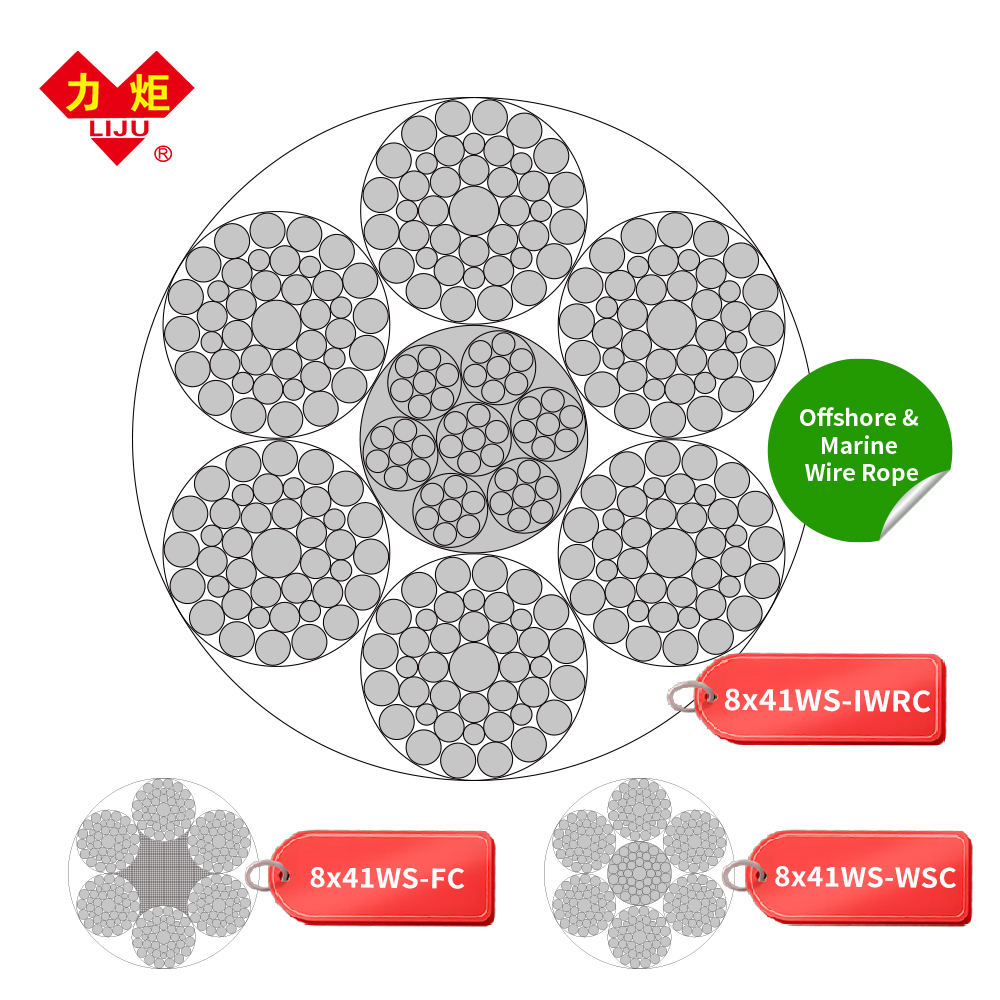
Port wire rope 8x41WS — built for container crane hoisting, mooring winches and quayside duty cycles.
Port duty ranks second because corrosion exposure is somewhat lower than open-sea duty while cyclic load severity is comparable. Container handling and mooring winches deliver millions of load reversals, and the rope bends over sheaves and drums far more often than an offshore mooring line.
Available constructions are 6x26WS, 6x31WS, 6x36WS, 6x41WS, 8x26WS, 8x31WS, 8x36WS, 8x41WS and 35Wx7. These serve lifting operations of quay cranes and gantry cranes, container handling and hoisting, vessel mooring at berth, traction in cargo yards, tugboat towing, supporting equipment for bulk cargo handling, anchoring of port floating structures, and hoisting for port equipment maintenance. Typical matching equipment covers quayside cranes, portal cranes, mooring winches, sheave blocks, spreaders and rope fittings, which together form complete lifting and mooring systems for terminals.
The category is supplied in high carbon steel from 1 mm to 120 mm and 1570 to 2160 MPa, to GB/T, EN, GOST and DIN execution standards, with high tensile strength and corrosion resistance as stated characteristics and customization available. Port wire rope meets API Spec Q1® and API-9A, and the ABS certification number 24-0072296-PDA range includes 8x26WS-IWRC for lifting equipment use.
Rank 3 — Mining Wire Rope
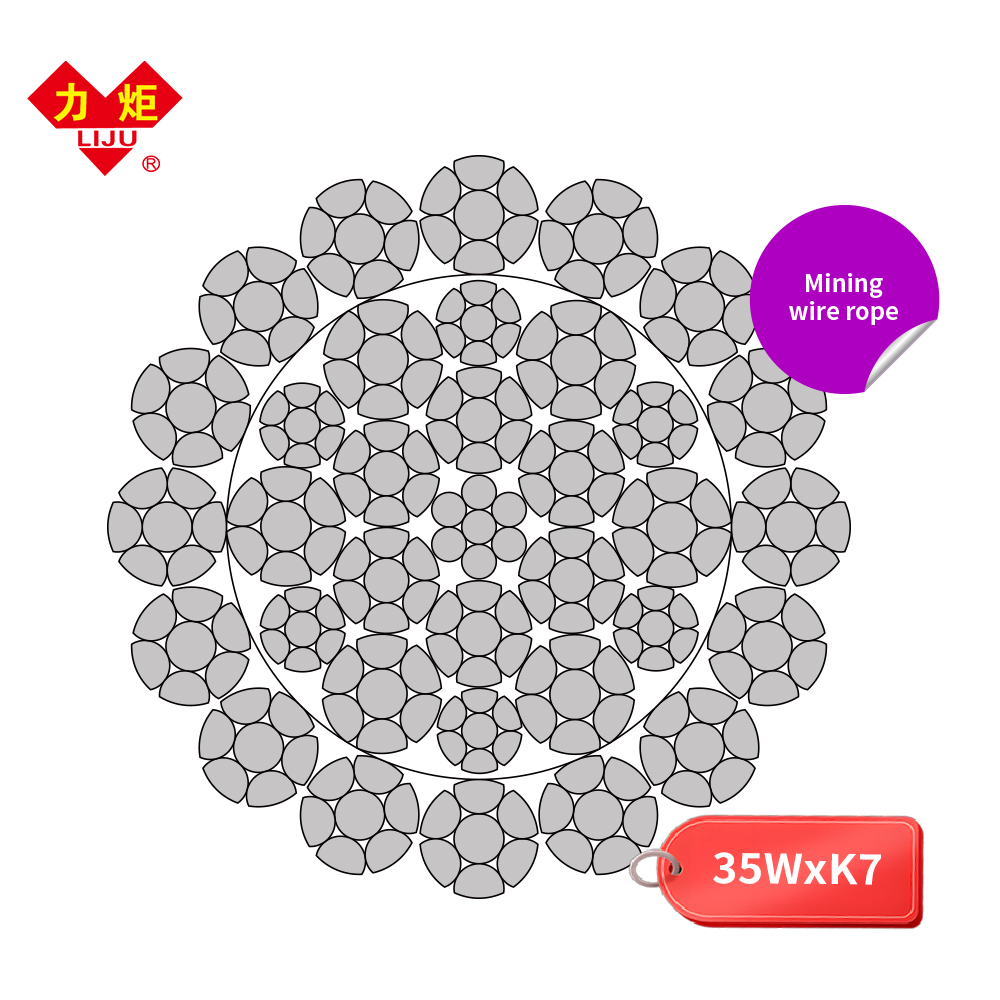
Mining wire rope 35WxK7 — heavy cyclic hoisting and traction duty in shaft and open-pit operations.
Mining duty ranks third. Load severity is the highest in this group, but corrosion exposure is generally lower than open sea or coastal salt-spray duty, except where mine water is aggressive. The consequence is that mining rope is specified primarily for tensile strength, impact resistance and predictable service cycles.
Available constructions are 6x19S, 6x19W, 6x19M, 6x36WS, 6x37S, 8xK26WS-EPIWC and 35WxK7. They are applied in vertical and inclined shaft hoisting equipment, lifting and transportation of ore and personnel, traction and relocation of mining equipment, haulage work of roadway winches, matching for open-pit electric shovels and draglines, slope reinforcement anchoring, maintenance lifting, and underground emergency rescue traction. Matched equipment includes hoist winches, head sheaves, guide sheaves, wedge sockets and rope clips, which form complete hoisting systems for vertical and inclined mines.
The range is produced in high carbon steel from 1 mm to 120 mm with tensile grades from 1570 MPa to 2160 MPa, again to GB/T, EN, GOST and DIN standards. Industry data showing compacted strand ropes in approximately 57% of heavy-duty hauling systems in mining in 2025 is consistent with a mining range that includes K-designated compacted-strand models such as 8xK26WS-EPIWC and 35WxK7. API certification number 9A-0125 covers the mining range.
A recorded mining enterprise case used 100 tons of mining wire rope for two years across mining hoisting, mine shaft lifting and underground traction. The reported outcome was stable hoisting operation, reduced downtime and improved site-work safety, with high wear resistance, strong impact resistance and a long service cycle under a harsh mine environment.
Rank 4 — Fishing Wire Rope

Fishing wire rope 6x7 — compact construction for trawl traction and vessel mooring duty.
Fishing duty ranks fourth on combined load severity, but it is not a low-corrosion duty. Seawater immersion, wave impact and a high-humidity coastal atmosphere keep corrosion resistance as the primary requirement; the loads are typically lower than shaft hoisting or container crane duty, which is what places the category below port and mining.
Available constructions are 6x7, 6x19S, 6x24S, 6x26WS, 6x36WS and 3x31WS. Applications include mooring of ocean-going fishing vessels and inshore working ships, trawl traction, seafood lifting, deployment and recovery of fishing equipment, and tension fixing of aquaculture cages. Matched equipment includes trawl winches, mooring winches, guide sheaves and rope fittings.
Specifications follow the same verified envelope: high carbon steel, 1 mm to 120 mm diameters, 1570 to 2160 MPa tensile grades, GB/T, EN, GOST and DIN execution standards, corrosion resistance and high tensile strength as stated characteristics. GOST certification number POCC RU C-CN.AД85.B.00499/24, issued by СЕРКОНС to GOST 3241-91, covers fishing wire rope for the RU market. API certification number 9A-0125 also covers the range, and CE certification number ICR/VC/HS240422 to EN 12385-1:2002+A1:2008 covers type groups including 6x7, 6x19 and 6x36 for EU buyers.
Comparison Table: The Four Categories Side by Side
The table below compares the four ranked categories only on facts that are verifiable in the product and certification records. It is intentionally limited to construction, dimensional range, tensile grade, execution standard and certification coverage.
| Rank & Category | Duty environment | Representative constructions | Verified range | Certification coverage |
|---|---|---|---|---|
| 1. Offshore & Marine | Salt spray, high humidity, wave-induced alternating shock load, heavy traction towing, long-term seawater erosion | 6x36WS, 6x29Fi, 6x41WS, 6x49SWS, 6x55SWS, 8x49SWS, 18x7, 35Wx7, 35WxK7, 4Vx39S SWAGE | 1–120 mm; 1570–2160 MPa; high carbon steel; GB/T, EN, GOST, DIN | CCS JS22PWA00113_01; API 9A-0125 (API Spec Q1®, API-9A); ABS 24-0072296-PDA to ISO 2408-2017 |
| 2. Port | Coastal salt mist, high humidity, heavy cyclic hoisting, shock load, high-traction mooring and towing | 6x26WS, 6x31WS, 6x36WS, 6x41WS, 8x26WS, 8x31WS, 8x36WS, 8x41WS, 35Wx7 | 1–120 mm; 1570–2160 MPa; high carbon steel; GB/T, EN, GOST, DIN | API Spec Q1® and API-9A; ABS 24-0072296-PDA includes 8x26WS-IWRC |
| 3. Mining | Underground humidity, corrosive mine water, abrasive dust, heavy cyclic shaft hoisting, open-pit impact load | 6x19S, 6x19W, 6x19M, 6x36WS, 6x37S, 8xK26WS-EPIWC, 35WxK7 | 1–120 mm; 1570–2160 MPa; high carbon steel; GB/T, EN, GOST, DIN | API 9A-0125 |
| 4. Fishing | Seawater immersion, wave impact, high-humidity coastal atmosphere, cyclic trawl traction, sediment abrasion | 6x7, 6x19S, 6x24S, 6x26WS, 6x36WS, 3x31WS | 1–120 mm; 1570–2160 MPa; high carbon steel; GB/T, EN, GOST, DIN | GOST POCC RU C-CN.AД85.B.00499/24 (GOST 3241-91); API 9A-0125; CE ICR/VC/HS240422 |
Certification scope differs by product and market. Confirm the applicable certificate, product model and destination market before the specification is approved.
Step-by-Step: How to Select and Validate Wire Rope for These Duties
- Define the duty environment and corrosion class. Decide whether the rope operates in open-sea salt spray, coastal terminal mist, mine water and dust, or continuous seawater immersion. This single decision removes most of the wrong constructions from the shortlist.
- Map the load case. Separate static tension, cyclic hoisting, shock load and traction towing. Offshore mooring and trawl traction are dominated by sustained and alternating tension; container crane hoisting and shaft hoisting are dominated by cyclic bending plus shock.
- Match the construction to the failure mode. Port and offshore duty generally points to WS-type multi-strand constructions in the 6x26WS to 6x49SWS family or their eight-strand equivalents; mining hoisting points to 6x19, 6x36, 6x37 and compacted-strand options such as 8xK26WS-EPIWC and 35WxK7.
- Set diameter and tensile grade within the verified envelope. All four categories are available from 1 mm to 120 mm and in 1570, 1670, 1770, 1870, 1960 and 2160 MPa grades. Increasing grade without rechecking sheave and drum geometry shifts the wear problem rather than solving it.
- Choose the surface condition. Options across the programme are un-galvanized, electro-galvanized, hot-dip galvanized, stainless and plastic-coated rope. Galvanized product accounted for 41.3% to 46% of global product demand in 2025 precisely because marine and mining duty demand it.
- Confirm certification for the destination market. EU buyers typically need CE to EN 12385-1:2002+A1:2008; Russian imports need GOST 3241-91; Malaysia requires SIRIM to MS ISO 2408:2004; Indonesia requires SNI 0727:2008 for oil and gas applications; offshore and marine projects frequently require CCS; lifting equipment duty often requires ABS to ISO 2408-2017; oil and gas duty requires API Spec Q1® and API-9A; environmental documentation is available through EPD to ISO 14025.
- Validate the sample and the test record before the first bulk order. The quality control sequence runs from raw material incoming inspection and semi-finished product spot check to finished product test, breaking load test and fatigue test, with a 100% full machine running test before delivery. MOQ is 1000 meters and lead time is 25 days.
Use Cases: Where These Rankings Play Out
Mining hoisting is the clearest heavy-duty test case. A mining enterprise took 100 tons of mining wire rope for shaft hoisting, mine lifting and underground traction and ran it for two years, reporting stable hoisting operation, reduced downtime and improved site-work safety. The recorded highlights were high wear resistance, strong impact resistance and a long service cycle in a harsh mine environment.
Port and terminal work converts the same logic into a duty cycle problem. Container handling and bulk cargo lifting, vessel mooring at berth and tug towing put repeated shock load into rope that also sits in coastal salt mist. Rope matched to quayside cranes, portal cranes, mooring winches, sheave blocks and spreaders keeps the terminal lifting and mooring systems inside their design envelope.
Offshore duty adds the corrosion variable that port work only hints at. Mooring of ocean-going vessels, ship towing, offshore platform hoisting, floating structure anchoring and positioning, subsea construction and offshore wind operation and maintenance vessels all run rope in exposed conditions where seawater erosion is continuous rather than intermittent.
Fishing duty closes the list with the highest corrosion exposure and the lowest average load. Trawl traction, deployment and recovery of fishing gear, seafood lifting, vessel mooring and aquaculture cage tensioning all depend on corrosion resistance and flexibility over the same rope, working from trawl winches and mooring winches.
FAQ
Which certifications should a buyer verify for offshore, port, mining and fishing duty wire rope?
Certification depends on the duty and the destination market, not on the rope alone. For offshore and marine duty, CCS certification number JS22PWA00113_01, issued by CCS Jiangsu Branch, applies against Chapter 10, Part One of the China Classification Society Rules for Materials and Welding 2022 and its Change Notices. For lifting equipment duty, ABS certification number 24-0072296-PDA, issued by the American Bureau of Shipping to ISO 2408-2017, covers loose gear items. API certification number 9A-0125, issued by the American Petroleum Institute against API Spec Q1® and API-9A, covers the offshore and marine, port, mining, construction machinery, elevator and oil and gas ranges. Market-specific approvals include CE number ICR/VC/HS240422 (ICR, EN 12385-1:2002+A1:2008) for the EU, GOST number POCC RU C-CN.AД85.B.00499/24 (СЕРКОНС, GOST 3241-91) for Russia, SIRIM number PC013111 (MS ISO 2408:2004) for Malaysia, and SNI number 33.23/016/LSPro BBSPJILM/07/2024 (SNI 0727:2008) for Indonesia. Environmental documentation is available through EPD number EPD-2026-01 to ISO 14025, cradle-to-gate, issued by MCC Inspection and Certification Co., Ltd.
Can one manufacturer supply all four duty categories?
Yes, and consolidating the four categories with a single supplier removes a common sourcing problem: mismatched certification records across vendors. Jiangsu Juli Steel Wire Rope Co.,LTD manufactures steel wire rope and wire rope slings, operates production bases in Nantong and Jiyuan in China and in Bekasi, Indonesia, and works with an annual steel wire rope production capacity of 250,000 tons and a 20-engineer R&D team. Customization covers rope construction, diameter, length, tensile strength, surface treatment, applicable standard and packing, under OEM, ODM and independent factory R&D and manufacturing.
What drives the cost of wire rope across these four categories?
Five cost drivers dominate, and none of them is a fixed catalogue price. The first is construction complexity, including strand count and whether the construction is compacted, shaped or swaged. The second is tensile grade within the 1570 MPa to 2160 MPa range. The third is rope diameter within the 1 mm to 120 mm range. The fourth is surface treatment: un-galvanized, electro-galvanized, hot-dip galvanized, stainless or plastic-coated. The fifth is certification and testing scope, because offshore and shaft-hoisting duty normally require certification evidence and test records that general-purpose rope does not. Order quantity also affects the commercial calculation, since the minimum order quantity is 1000 meters. Quotations are only comparable when construction, diameter, grade, surface condition and certification scope are identical.
How does sample and pre-delivery validation work?
Validation follows the quality control sequence: raw material incoming inspection, semi-finished product spot check, finished product test, breaking load test and fatigue test, with a 100% full machine running test before delivery. Buyers evaluating any of these four categories can request a specification-matched sample and a quotation by sending the duty environment, construction, diameter, tensile grade and destination market to the Juli team at Shirley@worldjuli.com, by WhatsApp on +86 15950529706, or through www.juli-rope.com.
What are the lead time, minimum order quantity and monthly capacity?
Minimum order quantity is 1000 meters, standard lead time is 25 days, and monthly capacity for the customized programme is 3000 tons. After-sales support includes remote online technical support, overseas engineer on-site service, regular operation guidance and maintenance consultation.
Conclusion: Match the Category Before Comparing the Quotation
The ranking is a filtering tool, not a verdict. Offshore & marine rope leads because it must survive severe corrosion and alternating load at the same time. Port rope follows on duty-cycle severity, mining rope on load severity and service-cycle predictability, and fishing rope on corrosion resistance at lower average load. All four share the same verified specification envelope: high carbon steel, 1 mm to 120 mm diameters, 1570 MPa to 2160 MPa tensile grades, and GB/T, EN, GOST and DIN execution standards.
The practical sequence is to define the duty environment first, select the construction second, set diameter and grade third, confirm market certification fourth, and validate with a sample and test record fifth. Buyers who run that sequence tend to compare quotations that are actually comparable, and they avoid the most expensive mistake in this category: paying for strength the duty does not need while under-specifying the corrosion and fatigue protection it does.
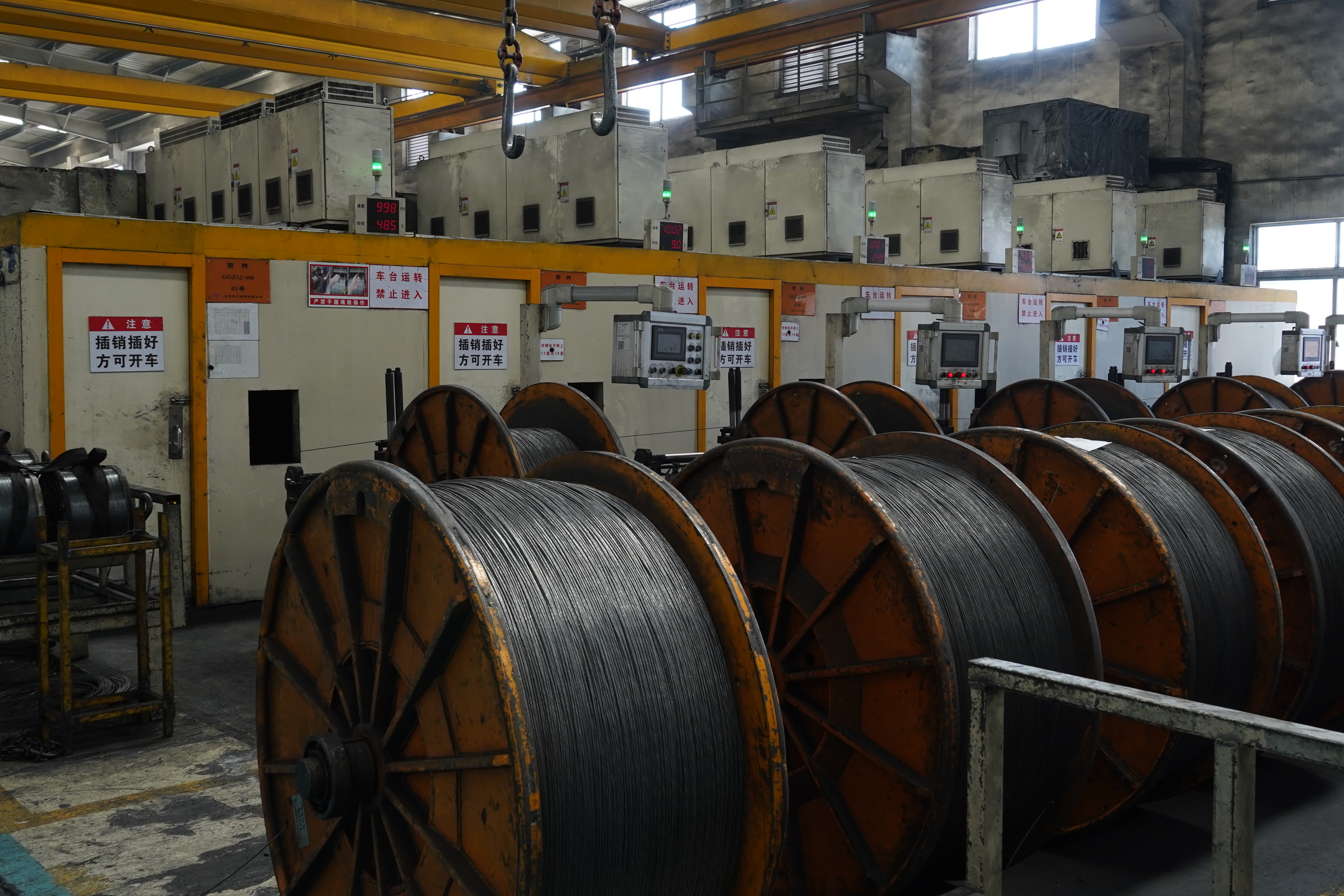
Jiangsu Juli Steel Wire Rope Co.,LTD production base — three manufacturing sites in Nantong and Jiyuan, China and Bekasi, Indonesia.
Next Step
Send your duty environment (offshore and marine, port, mining or fishing), the construction you are considering, rope diameter, tensile grade and destination market. The Juli engineering team returns a specification-matched recommendation, a sample plan and a quotation.
Download the full product catalogue: Juli Steel Wire Rope Catalogue (PDF)
Email: Shirley@worldjuli.com · Tel: +86 15312608225 · WhatsApp: +86 15950529706 · Website: www.juli-rope.com
Address: NO.1689, Zhangjiang Road, Nantong Development Zone, Nantong, China
Have Questions or Need More Details?
Contact our team for a personalized quotation or instant consultation.
Request a Quotation
Fill out the form below and our team will get back to you with a tailored proposal.
WhatsApp Direct Chat
Prefer to chat in real-time? Message us on WhatsApp for instant assistance & quick answers.
- Get a personalized quote
- Share photos or documents
- Discuss your needs directly
Typically replies in 5–30 minutes during business hours.