Steel Wire Rope Specification Guide: Diameter, Grade and Strand Construction
Steel wire rope is specified by three core parameters — rope diameter, tensile strength grade and strand construction — and then validated against a fourth decision: the execution standard.Jiangsu Juli Steel Wire Rope Co.,LTD manufactures high carbon steel wire ropes across a 1 mm to 120 mm diameter range, in tensile strengths of 1570, 1670, 1770, 1870, 1960 and 2160 MPa, in constructions that include 1x7, 1x19, 6x7, 6x19M, 6x36WS, 8x29Fi and 35WxK7, with GB/T, EN, GOST and DIN listed as the applicable execution standards. Matching those four variables to the working conditions of a specific duty — mine shaft hoisting, quayside crane work, elevator traction or farm winching — is what separates a rope that runs through its expected service cycle from one that is pulled early.
This guide is written for buyers and engineers who are still in research and evaluation: it explains how each parameter behaves in service, which constructions are documented for which industries, and how to lock a specification before an order is released.
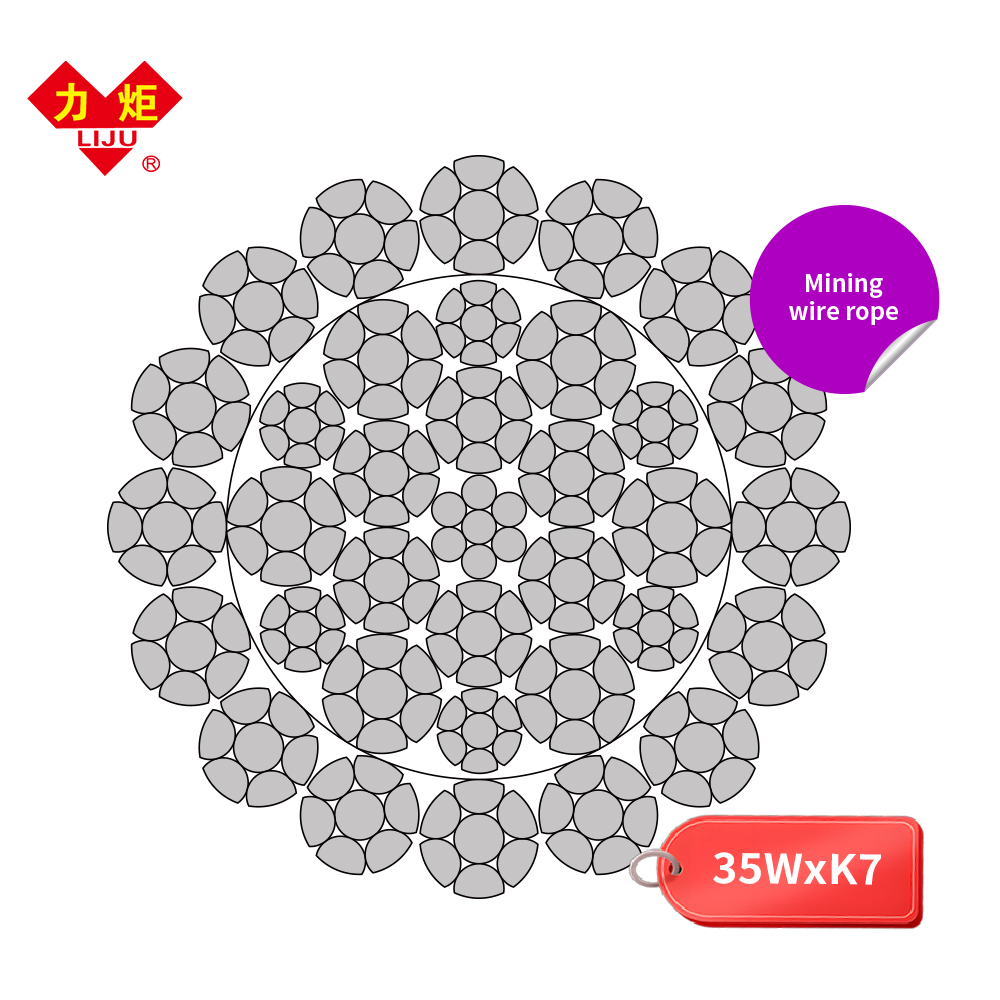
Cover: 35WxK7 — a construction listed across the mining, port, offshore & marine and oil & gas wire rope ranges.
Problem Definition: Why a Rope Fails on a Healthy Machine
Most rope complaints are specification complaints, not machine complaints. Four patterns account for a large share of early replacement, and each one points back to a different parameter:
- Bending geometry. A rope that is oversized for its sheave and drum set works at a higher bending stress on every revolution. Elevator duty is defined by frequent reciprocating cyclic bending inside an enclosed hoist shaft, so bending fatigue governs there rather than raw breaking force.
- Abrasion versus strength. In an underground mine with high humidity, an open-pit site with heavy dust, or a terminal handling containers with frequent shock loads, abrasion and impact — not tensile capacity — often decide service life.
- Construction mismatch. Ropes with fewer, thicker outer wires and ropes with many fine outer wires behave differently on multi-layer spooling and small sheaves. The same diameter can therefore be correct in one application and wrong in the next.
- Environment. Coastal salt spray, seawater immersion, mine water and high-temperature workshops all change the surface treatment decision, not the strength decision.
There is also a fifth, administrative failure: a rope that meets the mechanical requirement but is documented against a standard the receiving inspector does not accept is rejected at goods-in. That is why the execution standard belongs in the specification, not in the paperwork afterwards.
Because the parameters interact, changing one forces a re-check of the others. Reducing diameter to save weight, for example, usually means moving to a higher tensile grade or a construction with a better bending profile — and both changes move the cost and the test regime.
Industry Background: What the 2026 Rope Market Rewards
The global steel wire rope market was valued at USD 10.0 billion in 2026, according to Business Research Insights. The same source reports that galvanized steel wire ropes represented 46% of total product demand in 2025, driven by corrosion resistance. For buyers, that number explains why the finish decision is not cosmetic: on a global basis, roughly half of the rope moving into service is expected to survive a corrosive environment.
Trade classification matters as much as the technical file. Stranded wire, ropes and cables of iron or steel sit under HS code 731210, which is the reference point for landed-cost comparison when buyers evaluate suppliers across markets.
The standards landscape is split by market. BS EN 12385 — the BSI publication covering steel wire ropes safety and stranded ropes for general lifting applications — is the baseline reference for EU and UK market access. For Indonesian petroleum and natural gas work, SNI 0727:2008 applies, a certification Jiangsu Juli Steel Wire Rope Co.,LTD holds with an effective date of 2024-07-04.
On the supply side, Jiangsu Juli Steel Wire Rope Co.,LTD is a manufacturer of steel wire ropes and lifting accessories operating three production bases — Nantong and Jiyuan in China and Bekasi in Indonesia — with origins dating back to 1958 and a founding year of 1995. The company reports total assets of USD 150 million, a site area of 350,000 square meters and an annual production capacity of 250,000 tons of steel wire rope, supported by 42 distribution centers in major Chinese cities, offices in more than 30 countries and regions, and an export ratio of 30%. Its product range covers un-galvanized, electro-galvanized, hot-dip galvanized, stainless and plastic-coated ropes, with constructions that include bundling ropes, cross laid, parallel laid, anti-rotation, compacted strand, shaped strand and locked coil ropes. Certifications held include API, LR, ABS, CCS, ISO9001, CE, GOST, EPD, SIRIM, SNI and MA.
The Three Parameters, Explained as Decisions
1. Diameter: 1 mm to 120 mm
Diameter sets the load envelope and, in practice, the whole machine interface. The documented range runs from 1 mm to 120 mm, and it is used very differently at each end. At the small end, the micro and specialty range is built on 6x7, 6x19S, 6x36WS, 18x7 and 35Wx7 for precision instruments, medical devices, automation, robotics and fitness equipment, where high dimensional accuracy and flexibility matter more than tonnage. At the large end, single ropes in mining, port and offshore duty are selected around shaft hoisting, container handling and mooring loads.
Two practical rules follow. First, confirm the sheave and drum set before finalising the diameter, because an oversized rope converts a healthy machine into a fatigue test rig. Second, treat diameter and grade as a pair: a load can sometimes be carried by a smaller, higher-grade rope, but only if the bending profile of the construction allows it.
2. Tensile Strength: 1570 to 2160 MPa
Six grades are available across the range: 1570, 1670, 1770, 1870, 1960 and 2160 MPa. The grade is the property that turns a diameter into a breaking force, and it is the first lever pulled when a project is weight- or space-constrained — higher grades raise capacity without adding diameter. The trade-off is that higher-grade rope places tighter demands on the whole chain: wire quality, stranding, and the test evidence that proves the finished rope reaches the grade claimed.
That is why the grade decision should always be paired with a verification decision. On Juli production, the quality chain covers raw material incoming inspection, semi-finished product spot checks, finished product testing, breaking load testing and fatigue testing, plus a 100% full machine running test before delivery. For a buyer, the useful question is not only “which grade?” but “which test record will prove it?”
3. Strand Construction: What the Rope Is Asked to Do
Construction is the parameter buyers most often leave to the supplier, and the one that most often causes a mismatch. The documented constructions differ in wire count, strand count and strand shape, and each appears in a defined set of industry ranges:
- 1x7 and 1x19 — single-strand, low-flex work. They appear in the agricultural range (1x7, 1x19) and the power range (1x7, 1x19), where the job is tensioning, guying and conductor pulling rather than repeated bending over sheaves.
- 6x7 — a compact six-strand construction listed in the fishing range and the agricultural range, used where small drums and abrasive contact dominate.
- 6x19M — a general-purpose workhorse listed in mining, heavy-duty, construction & engineering, construction machinery, agricultural and power ranges.
- 6x36WS — a flexible multi-strand construction listed across cable car, fishing, logging forestry, port, offshore & marine, mining, heavy-duty, oil & gas and construction ranges. It is the construction most often chosen where bending and spooling dominate.
- 8x29Fi — an eight-strand construction listed in the construction & engineering range, spreading load across more strands for site hoisting and traction duty.
- 35WxK7 — a large-diameter construction listed in mining, port, offshore & marine, oil & gas and construction & engineering ranges. It belongs to the anti-rotation family of constructions produced by the company.
- Compacted and shaped strand variants — such as 6xK36WS and 8xK26WS-EPIWC, listed in oil & gas, construction machinery, logging forestry and mining ranges, where a denser rope cross-section is wanted.

6x19M — a general-purpose construction documented across mining, heavy-duty, construction and agricultural ranges.
4. The Fourth Decision: Execution Standard
GB/T, EN, GOST and DIN are the execution standards listed for the range. The technical content of a specification can be identical while the document set differs, so the standard should be named at the enquiry stage together with any market-specific approval the project requires — BS EN 12385 for EU and UK lifting work, SNI 0727:2008 for Indonesian petroleum and natural gas work, or the API, LR, ABS and CCS approvals where classification is part of the contract.
Step-by-Step: Building the Specification
- Define the operating cycle. Write down whether the rope works in reciprocating winding with intermittent load, continuous cyclic hoisting, or frequent reciprocating bending — and whether the site is dusty, humid, high-temperature or salt-spray exposed.
- Fix the diameter band. Confirm the sheave and drum geometry, then choose a diameter within the 1–120 mm range that the machine can actually bend.
- Set the tensile grade. Select from 1570, 1670, 1770, 1870, 1960 or 2160 MPa. State plainly whether the grade is being used to save diameter or to add capacity, because that determines how much test evidence is needed.
- Choose the construction against three stresses. Bending and spooling, abrasion and impact, and rotation. This is where 6x19M, 6x36WS, 8x29Fi and 35WxK7 separate from each other.
- Select the surface treatment. Decide between un-galvanized, electro-galvanized, hot-dip galvanized, stainless and plastic-coated finishes based on the corrosion load on site.
- Name the standard. Specify GB/T, EN, GOST or DIN, and add the market approval if the destination requires one.
- Lock the commercial frame. Confirmation points are construction, diameter, length, tensile strength, surface treatment, applicable standard and packing; the minimum order quantity is 1,000 meters and the standard lead time is 25 days.

6x7 — a compact six-strand construction listed in the fishing and agricultural ranges, where small drums and abrasive contact dominate.
Use Cases: Which Range Fits Which Duty
The clearest way to read a rope catalogue is by working condition. Each industry range in the Juli product set carries its own construction list, and the conditions attached to each range show what the rope is expected to survive.
Mining and heavy-duty. Mining rope covers 6x19S, 6x19W, 6x19M, 6x36WS, 6x37S, 8xK26WS-EPIWC and 35WxK7, for vertical and inclined shaft hoisting in humid underground conditions or dusty open-pit sites, matched with hoist winches, head sheaves, guide sheaves, wedge sockets and rope clips. Heavy-duty rope covers 6x19S, 6x19W, 6x26WS, 6x36WS, 6x31WS, 8xK26WS, 6x19M and 6x37M, aimed at mining, construction, lifting and hoisting, port, heavy industry and metallurgy, including high-temperature workshops.
Port, offshore and oil & gas. Port rope runs from 6x26WS to 8x41WS plus 35Wx7, for quayside and gantry crane lifting, container handling, vessel mooring and tug towing under coastal salt spray. Offshore & marine rope extends to the larger multi-strand and swaged constructions — 6x49SWS, 6x55SWS, 6x61FWS, 6x84WSNS, 6x127SWSNS, 8x49SWS to 8x127SWSNS, 18x7, 35Wx7, 35WxK7 and 4Vx39S / 4Vx48S SWAGE — for vessel mooring, towing and offshore platform lifting. Oil & gas rope covers 6x19S through 6x84WSNS, 6xK26WS, 6xK36WS, 8xK26WS, 8xK36WS and 35WxK7 for onshore rigs and offshore platforms, where the rope runs in cyclic tension over the drawworks, crown block and travelling block.

4x31WS — one of the constructions listed in the construction & engineering range, alongside 6x19S, 6x29Fi, 6x36WS, 8x29Fi and 35WxK7.
Construction and construction machinery. Construction & engineering rope spans 6x19S, 6x19W, 6x29Fi, 6x36WS, 8x29Fi, 6xK36WS, 18x7, 35Wx7, 35WxK7, 4Vx39S, 8x19S, 4x26WS, 4x31WS, 6x19M, 6x37M, 6x12-7FC and 6x15-7FC for tower cranes, construction hoists, material hoists and gondolas on open-air sites with dynamic shock loads. Construction machinery rope covers 6x25Fi, 6x29Fi, 6x36WS, 6xK36WS, 18x7, 35Wx7, 35WxK7 and 4Vx39S for truck-mounted cranes, crawler cranes, pile drivers, drilling rigs, excavators and loaders.
Agriculture, forestry, fishing and power. Agricultural rope uses 1x7, 1x19, 6x7, 7x7, 6x19M, 6x12-7FC, 6x15-7FC and 6x24MFC for greenhouse tensioning, machinery towing, irrigation erection and livestock fencing. Logging forestry rope uses 6x19S, 6x19M, 6x26WS, K6x26WS and K6x36WS for log skidding, timber towing and forest ropeway transport. Fishing rope uses 6x7, 6x19S, 6x24S, 6x36WS, 6x26WS and 3x31WS for trawl hoisting, ship mooring and aquaculture cage fixing. Power rope uses 1x7, 1x19, 6x7, 6x19M and 6x37M for tower erection, conductor pulling, wind power hoisting and gate operation.
Elevator, cable car and micro. Elevator rope uses 8x19S, 8x19W, 6x19S and 6x19W in high carbon steel, matched with traction machines, traction sheaves, deflector sheaves and rope termination assemblies. Cable car rope uses 6x19S, 6x36WS and 6x37S for mono-cable circulating gondola ropeways, chairlifts, aerial tramways, funicular railways and ski surface tows under wind, snow and ice exposure. Micro and specialty rope uses 6x7, 6x19S, 6x36WS, 18x7 and 35Wx7 for compact, high-cycle installations.
Comparison Table: Constructions and Documented Duties
The table below uses only constructions and industry ranges documented in the Juli product range. All entries are available in the 1–120 mm diameter band with tensile options from 1570 to 2160 MPa and GB/T, EN, GOST or DIN execution.
| Construction | Documented industry ranges | Selection driver |
|---|---|---|
| 1x7 / 1x19 | Agricultural, Power | Static tensioning, guying, conductor pulling — work without repeated sheave bending |
| 6x7 | Fishing, Agricultural | Compact strand build for small drums and abrasive contact |
| 6x19M | Mining, Heavy-Duty, Construction & Engineering, Construction Machinery, Agricultural, Power | General hoisting, traction and load bearing |
| 6x36WS | Cable Car, Fishing, Logging Forestry, Port, Offshore & Marine, Mining, Heavy-Duty, Oil & Gas, Construction & Engineering | Bending and spooling duty; multi-strand flexibility |
| 8x29Fi | Construction & Engineering | Eight-strand load distribution for site hoisting and traction |
| 35WxK7 | Mining, Port, Offshore & Marine, Oil & Gas, Construction & Engineering | Large-diameter anti-rotation family for shaft hoisting and mooring duty |
| 6xK36WS / 8xK26WS-EPIWC | Oil & Gas, Construction Machinery, Logging Forestry, Mining | Compacted strand for a denser cross-section in abrasive duty |
All ropes in the table: high carbon steel, diameter 1–120 mm, tensile strength 1570/1670/1770/1870/1960/2160 MPa, execution to GB/T, EN, GOST or DIN.
Field Case: 100 Tons of Mining Hoist Rope Over Two Years
A mining enterprise client ordered 100 tons of mining wire rope for mine shaft lifting and underground traction. The project ran for two years and reported stable hoisting operation, reduced downtime and improved site-work safety. The performance notes attached to the case are high wear resistance, strong impact resistance and a long service cycle in a harsh mine environment — exactly the properties the mining range is specified around, where underground humidity and open-pit dust act on the rope at the same time.
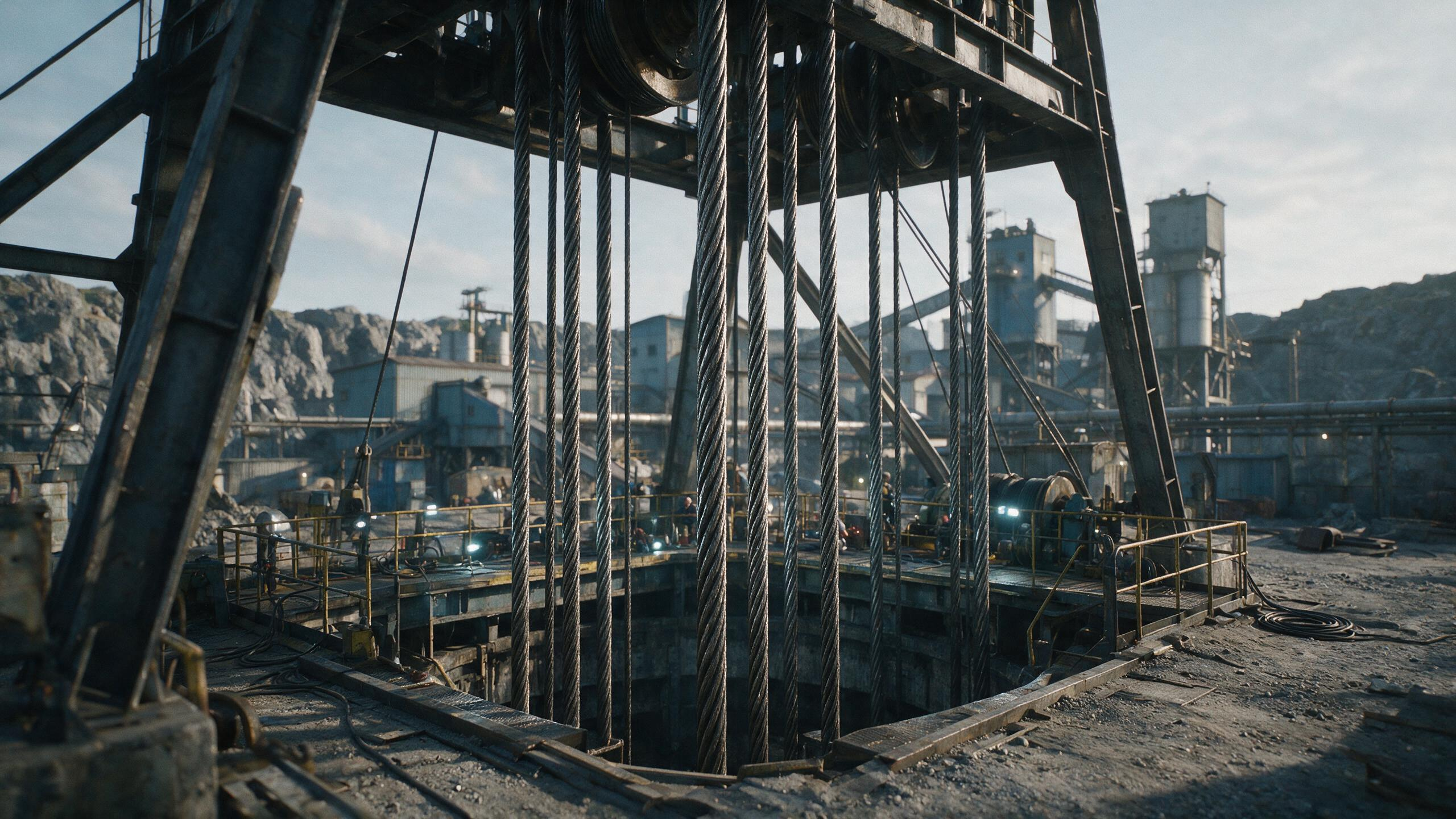
Mining duty: shaft hoisting and underground traction, where wear resistance and impact resistance decide the service cycle.
The transferable lesson for other projects is that the specification was fixed before the order: construction and diameter matched to shaft hoisting, grade matched to the load case, and the rope documented for acceptance. The gain appeared not in the rope price but in the operating numbers — downtime and site safety.
FAQ
Which execution standard should be specified — GB/T, EN, GOST or DIN?
GB/T, EN, GOST and DIN are all listed as applicable execution standards for the Juli range, so the choice is driven by the destination market and the receiving inspector rather than by rope capability. For EU and UK lifting applications, BS EN 12385 is the safety reference for stranded ropes. For Indonesian petroleum and natural gas work, SNI 0727:2008 applies and Juli holds that certification, effective 2024-07-04. Where classification is required, API, LR, ABS, CCS and MA approvals are also held, alongside ISO9001, CE, GOST, EPD and SIRIM.
Can one supplier cover both a 6 mm fishing rope and a 120 mm mining hoist rope?
Yes. The documented range runs from 1 mm to 120 mm in high carbon steel, with tensile options from 1570 to 2160 MPa and constructions covering single-strand, six-strand, eight-strand, multi-strand, compacted, shaped strand and anti-rotation types. Production is organised across three bases — Nantong and Jiyuan in China and Bekasi in Indonesia — with an annual capacity of 250,000 tons, and customization is available on construction, diameter, length, tensile strength, surface treatment, applicable standard and packing.
What drives the cost difference between a standard rope and a high-grade or compacted rope?
Cost follows the specification, not the diameter alone. Four variables move it: the tensile grade selected (2160 MPa sits at the top of the six available grades), the construction (compacted and shaped strand builds such as 6xK36WS, 8xK26WS-EPIWC and 35WxK7 carry more process steps than 6x19M), the surface treatment (un-galvanized, electro-galvanized, hot-dip galvanized, stainless or plastic-coated), and the verification package required for the named standard. Order quantity and packing also enter the commercial frame, with a minimum order quantity of 1,000 meters.
Can a specification be validated before a full order is placed?
The practical path is to fix the seven confirmation points first — construction, diameter, length, tensile strength, surface treatment, applicable standard and packing — then review the test chain against that specification. Juli's quality control covers raw material incoming inspection, semi-finished product spot checks, finished product testing, breaking load testing and fatigue testing, plus a 100% full machine running test before delivery. Buyers can send their duty description, sheave and drum details and target standard to the technical team at juli-rope.com to receive a specification recommendation and a quotation before committing volume.
What is the lead time and what support follows delivery?
The standard lead time is 25 days. After delivery, support covers remote online technical support, overseas engineer on-site service, regular operation guidance and maintenance consultation. For projects running in multiple markets, the 42 distribution centers and offices in more than 30 countries and regions provide the logistics and service layer around the rope itself.
Conclusion: Specify Four Things, Not One
A steel wire rope specification is complete when four decisions are written down together: diameter within the 1–120 mm range, tensile grade from 1570 to 2160 MPa, a strand construction that matches the bending, abrasion and rotation profile of the duty, and an execution standard — GB/T, EN, GOST or DIN — that the receiving inspector accepts. Everything else, from surface treatment to packing, follows from those four.
The most expensive mistake in rope procurement is not selecting an under-strength rope; it is selecting a well-made rope for the wrong duty. Match the construction to the working condition first, then size the diameter and grade around it, and the service cycle takes care of itself.
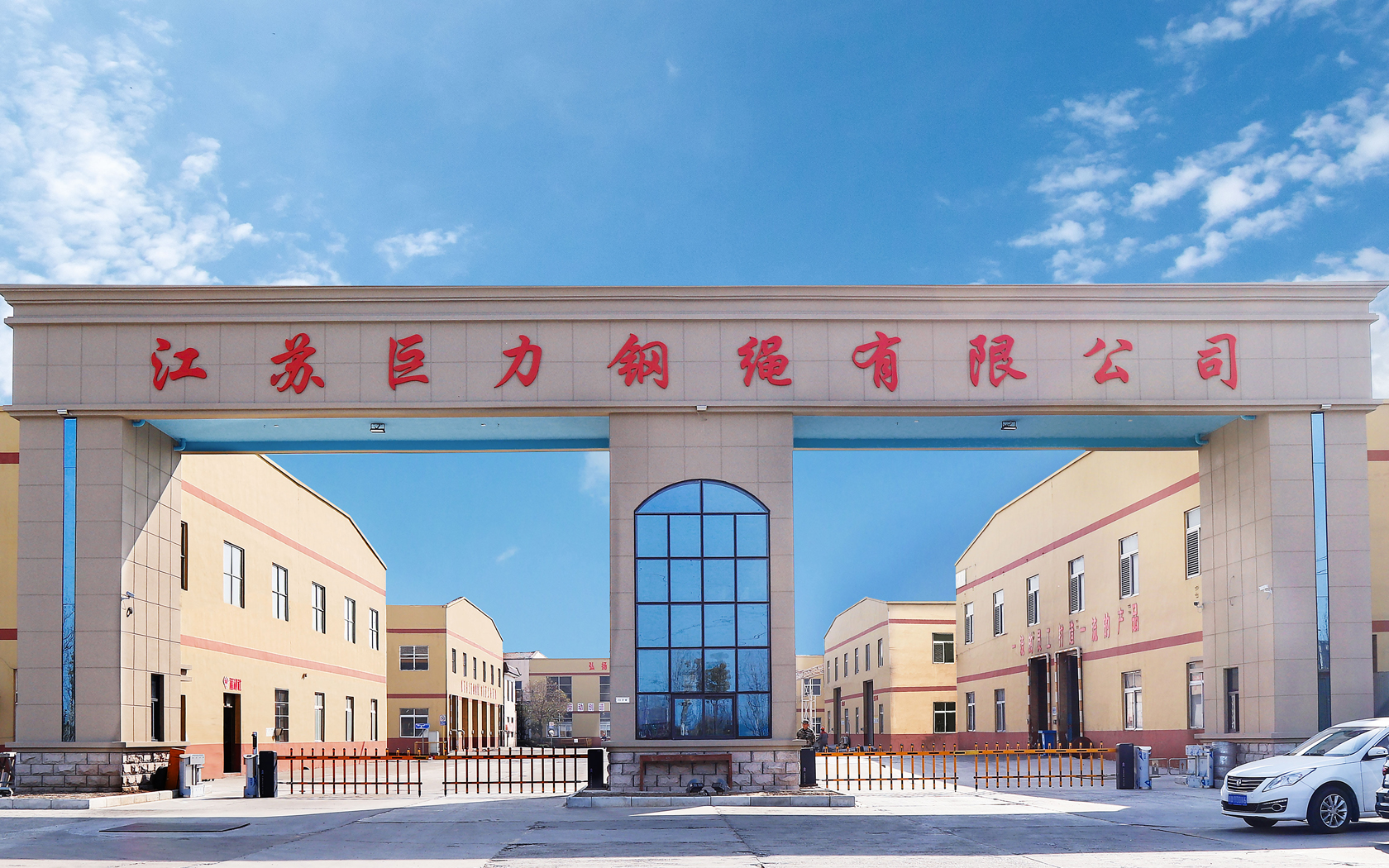
Next step: match a construction to your duty
Jiangsu Juli Steel Wire Rope Co.,LTD supplies steel wire ropes and lifting accessories, with customization on construction, diameter, length, tensile strength, surface treatment, standard and packing at a minimum order quantity of 1,000 meters and a 25-day lead time. Send your working conditions, sheave and drum data and target standard to receive a specification recommendation and a quotation.
Contact: Shirley | Email: Shirley@worldjuli.com | Tel: +86 15312608225 | WhatsApp: +86 15950529706
Address: NO.1689, Zhangjiang Road, Nantong Development Zone, Nantong | Website: www.juli-rope.com
Download the full product catalogue (diameters, constructions, standards): Juli Steel Wire Rope Catalogue (PDF)
Have Questions or Need More Details?
Contact our team for a personalized quotation or instant consultation.
Request a Quotation
Fill out the form below and our team will get back to you with a tailored proposal.
WhatsApp Direct Chat
Prefer to chat in real-time? Message us on WhatsApp for instant assistance & quick answers.
- Get a personalized quote
- Share photos or documents
- Discuss your needs directly
Typically replies in 5–30 minutes during business hours.