Mining Wire Rope vs Heavy-Duty Wire Rope: A Head-to-Head Hoisting Decision
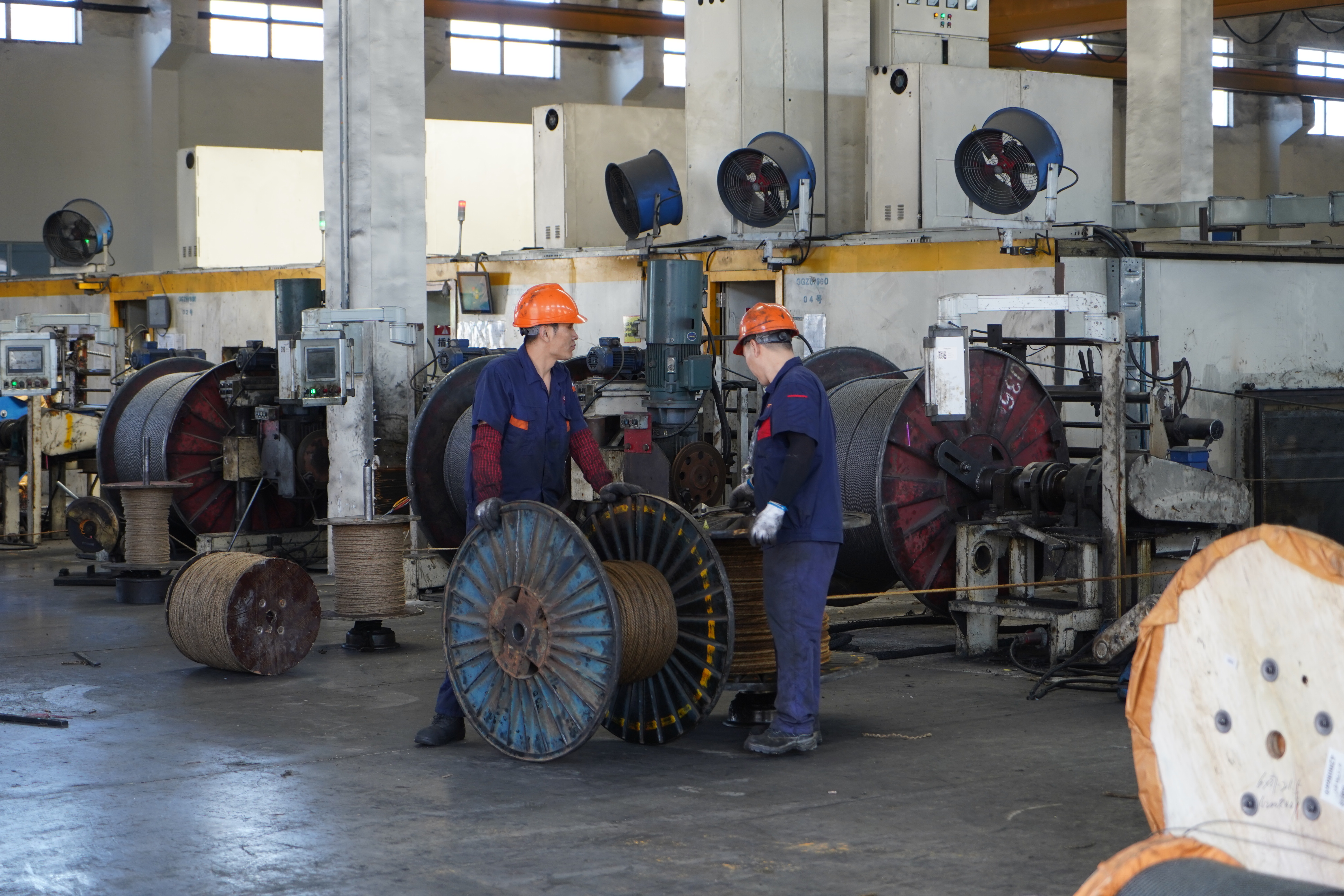
Two product families sit side by side in the same catalogue, are drawn from the same raw material, and are quoted across the same diameter range, yet they are specified for different jobs. Mining wire rope is intended for mining hoisting and excavating equipment. Heavy-duty wire rope is designed for a wider envelope: mining, construction, lifting and hoisting, port operations, and heavy industry. When a hoisting or excavating project reaches the purchase-order stage, someone has to decide which family the order belongs to.
Direct answer: If every rope in the order goes onto mining hoisting or excavating equipment, specify mining wire rope, whose construction list is built around that duty. If the same procurement covers lifting and hoisting, port operations, construction, metallurgy or mixed heavy-industry fleets, specify heavy-duty wire rope. Both families share the same baseline: high-carbon steel, a 1–120 mm diameter range, tensile grades of 1570, 1670, 1770, 1870, 1960 and 2160 MPa, and GB/T, EN, GOST and DIN execution standards. Corrosion resistance is not decided by the family name; it is decided by the surface treatment attached to the order.
Problem Definition: Why the Two Families Overlap
The difficulty in this decision is not finding a rope. It is that the two families overlap. Heavy-duty wire rope lists mining among its applicable industries, so a mining project can legitimately be quoted either product. That overlap produces three practical problems.
- Duty mismatch. A rope selected for general heavy-duty lifting may not match the specific construction profile a shaft hoist or an excavator duty calls for. The reverse also holds: a mining-specific rope may be specified for a port crane fleet where the wider heavy-duty range would have covered the whole fleet more simply.
- Corrosion assumptions. Corrosion resistance is often assumed from the product family name instead of being defined from the environment. Mine drainage, wet shafts, coastal humidity and salt exposure push the surface-treatment decision in different directions.
- Procurement fragmentation. When a site runs mining hoists alongside construction lifting or port equipment, ordering from two families can produce two specification documents, two acceptance paths and two spare-rope references.
The decision is therefore not about which family is stronger. Both are produced from high-carbon steel, both cover a 1–120 mm diameter range, and both are available in 1570, 1670, 1770, 1870, 1960 and 2160 tensile grades. The real question is how narrow or wide the duty definition is, which constructions that duty requires, and what the environment demands from the rope surface.
Industry Background: What Is Shifting in Hoisting Demand
Demand for hoisting rope continues to expand. The global steel wire rope market is projected to reach USD 13.88 billion by 2030, up from USD 10.49 billion in 2025, at a CAGR of 5.8% (MarketsandMarkets). Construction remains the largest end-user segment, accounting for approximately 27%–40.7% of total market share in 2024–2025 according to Grand View Research and related industry research.
Two technical trends matter directly to this comparison. First, compacted and multi-strand constructions have moved into mainstream heavy hauling: mining operations adopted compacted strand ropes in approximately 57% of heavy-duty hauling systems globally in 2025 (Business Research Insights). That trend is visible inside mining wire rope ranges, which include compacted and multi-strand options such as 8*K26WS-EPIWC and 35W*K7. Second, corrosion resistance has become a purchasing driver rather than a finishing detail: galvanized steel wire ropes accounted for 41.3%–46% of total product demand globally in 2025, a share attributed to high corrosion resistance requirements in marine and mining environments (Dataintelo).
The standards baseline is shared as well. ISO 2408:2017 specifies the minimum requirements for the manufacture and testing of steel wire ropes for general purposes, including lifting and rigging. Both families covered in this comparison are produced to GB/T, EN, GOST and DIN execution standards, which forms the common technical floor a buyer can compare against before narrowing to one family.
Head-to-Head: Mining Wire Rope vs Heavy-Duty Wire Rope
The table below compares the two families on the dimensions a buyer actually evaluates: application scope, construction availability, corrosion strategy, and the shared technical baseline.
| Decision dimension | Mining wire rope | Heavy-duty wire rope |
|---|---|---|
| Intended application | Mining hoisting and excavating equipment | Mining, construction, lifting & hoisting, port operations, heavy industry, metallurgy |
| Construction options | 6*19S, 6*19W, 6*19M, 6*36WS, 6*37S, 8*K26WS-EPIWC, 35W*K7 | 6*19S, 6*19W, 6*19M, 6*26WS, 6*36WS, 6*31WS, 8*K26WS, 6*37M |
| Base material | High carbon steel | High carbon steel |
| Diameter range | 1–120 mm | 1–120 mm |
| Tensile strength grades | 1570, 1670, 1770, 1870, 1960, 2160 MPa | 1570, 1670, 1770, 1870, 1960, 2160 MPa |
| Execution standards | GB/T, EN, GOST, DIN | GB/T, EN, GOST, DIN |
| Corrosion resistance | Delivered through surface treatment — un-galvanized, electro-galvanized, hot-dip galvanized, stainless or plastic-coated | Delivered through the same surface-treatment options, selected by environment |
| Decision trigger | Order is confined to mining hoisting and excavating duty | Order spans lifting, port, construction, metallurgy or mixed-duty fleets |
1. Application specificity
Application specificity is the cleanest separating line. Mining wire rope is scoped to mining hoisting and excavating equipment, which means the constructions, duty assumptions and acceptance discussions all start from a single equipment family. Heavy-duty wire rope is scoped across mining, construction, lifting & hoisting, port, heavy industry and metallurgy — six industry settings served by one product family. Buyers who know their entire rope requirement sits inside one of those two envelopes can decide on scope alone, without any further technical comparison.
2. Construction options
The construction lists are where the two families visibly part company, and also where they briefly touch. 6*19S, 6*19W, 6*19M and 6*36WS appear on both sides, so construction overlap alone cannot settle the decision.
Where they differ is at the edges of the range. Mining wire rope includes 8*K26WS-EPIWC and 35W*K7 — compacted and multi-strand styles that are commonly selected where heavy hauling, abrasion and deformation resistance dominate the duty cycle. Heavy-duty wire rope includes 6*26WS and 6*31WS, which broaden coverage toward general lifting and hoisting duties across construction and port equipment.
In selection practice, the general logic runs as follows. Standard six-strand constructions such as 6*19S and 6*19W are the common workhorses for routine hoisting duty. Constructions with more wires per strand, such as 6*36WS, 6*37S and 6*31WS, are typically chosen where repeated bending over sheaves and drums dominates rope life. Compacted and multi-strand constructions are generally chosen where abrasion, crushing and cross-section stability matter more than flexibility. The relevant question is not which list is longer, but which list contains the construction the duty actually requires.
3. Corrosion resistance
Neither family carries a corrosion class in its name. What differs is how the rope is finished. The manufacturer produces un-galvanized, electro-galvanized, hot-dip galvanized, stainless and plastic-coated wire ropes across its range, and surface treatment is a customization input available on both mining and heavy-duty orders.
This changes the buyer's question from "which family resists corrosion better" to "which treatment does this environment require". Heavy-duty rope is frequently specified where port operations and heavy industry expose a rope fleet to humidity and salt. Mining rope is frequently specified where drainage water, slurry and shaft moisture are present. In both cases, the treatment carries the corrosion performance, not the family label. Galvanized constructions are the most widely adopted answer: they accounted for 41.3%–46% of global demand in 2025, a share linked to corrosion performance in mining and marine environments (Dataintelo).
4. The shared baseline
Because the baseline is identical, buyers should not expect the family choice to change strength, size availability or standards compliance. Both families use high-carbon steel, both run from 1 mm to 120 mm in diameter, both are available in 1570, 1670, 1770, 1870, 1960 and 2160 MPa tensile grades, and both are manufactured to GB/T, EN, GOST and DIN execution standards. Diameter and tensile grade are specified per order either way, and both are listed as customization inputs alongside construction, length, surface treatment, applicable standard and packing.
One Supplier, Two Product Families: The Manufacturing Position
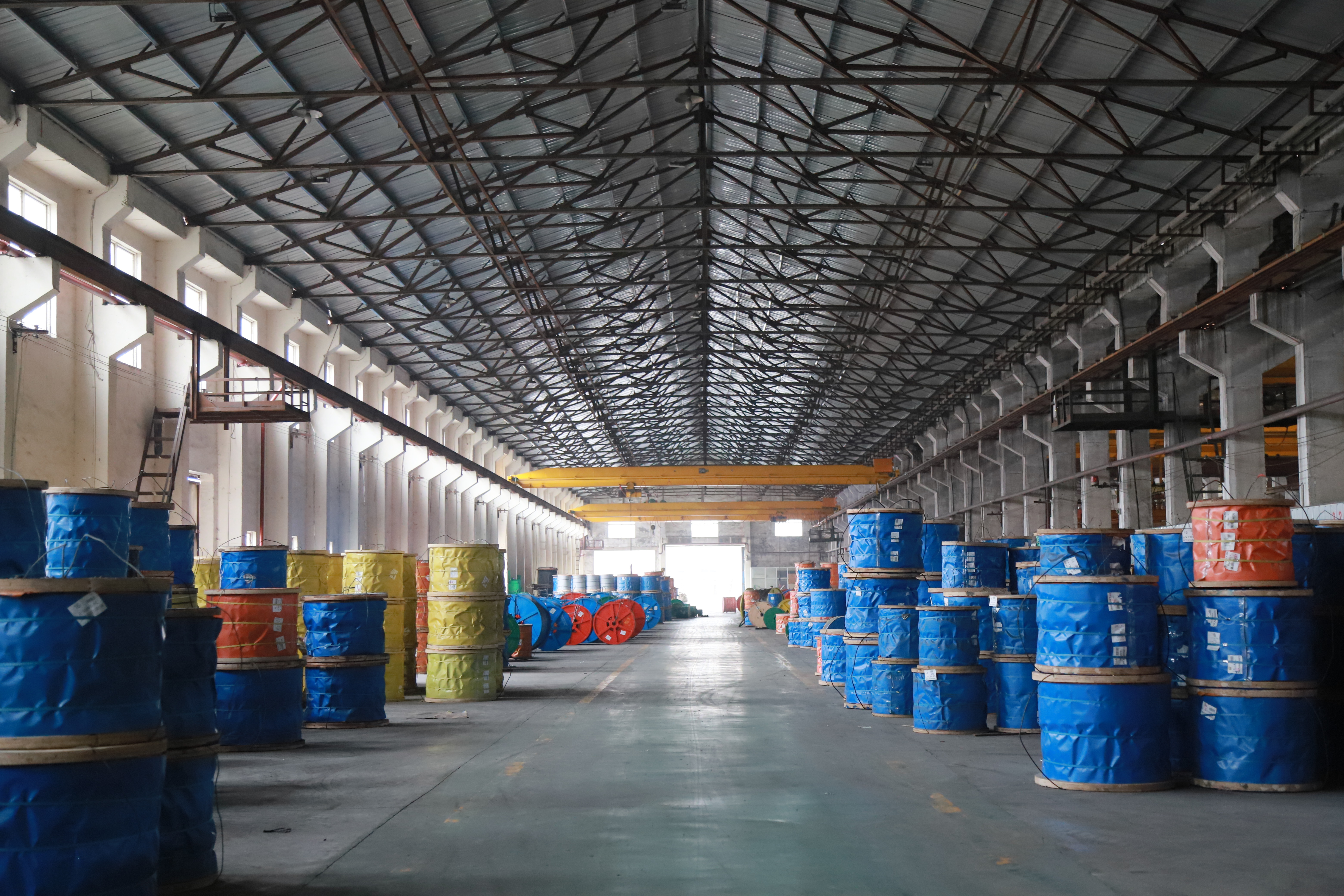
Jiangsu Juli Steel Wire Rope Co.,LTD is a manufacturer of steel wire ropes and lifting accessories, operating production bases in Nantong and Jiyuan in China and in Bekasi, Indonesia. Both product families discussed here — mining wire rope and heavy-duty wire rope — are manufactured within that production system, alongside the wider range that includes port, offshore and marine, oil and gas, elevator, power, fishing, logging and agricultural wire ropes.
For buyers at the evaluation-to-execution stage, the relevant capability is customization scope. The manufacturer offers OEM, ODM and independent factory R&D & manufacturing services, with customization covering wire rope construction, diameter, length, tensile strength, surface treatment, applicable standard and packing. Monthly capacity is 3000 tons, standard lead time is 25 days, and the minimum order quantity is 1000 meters.
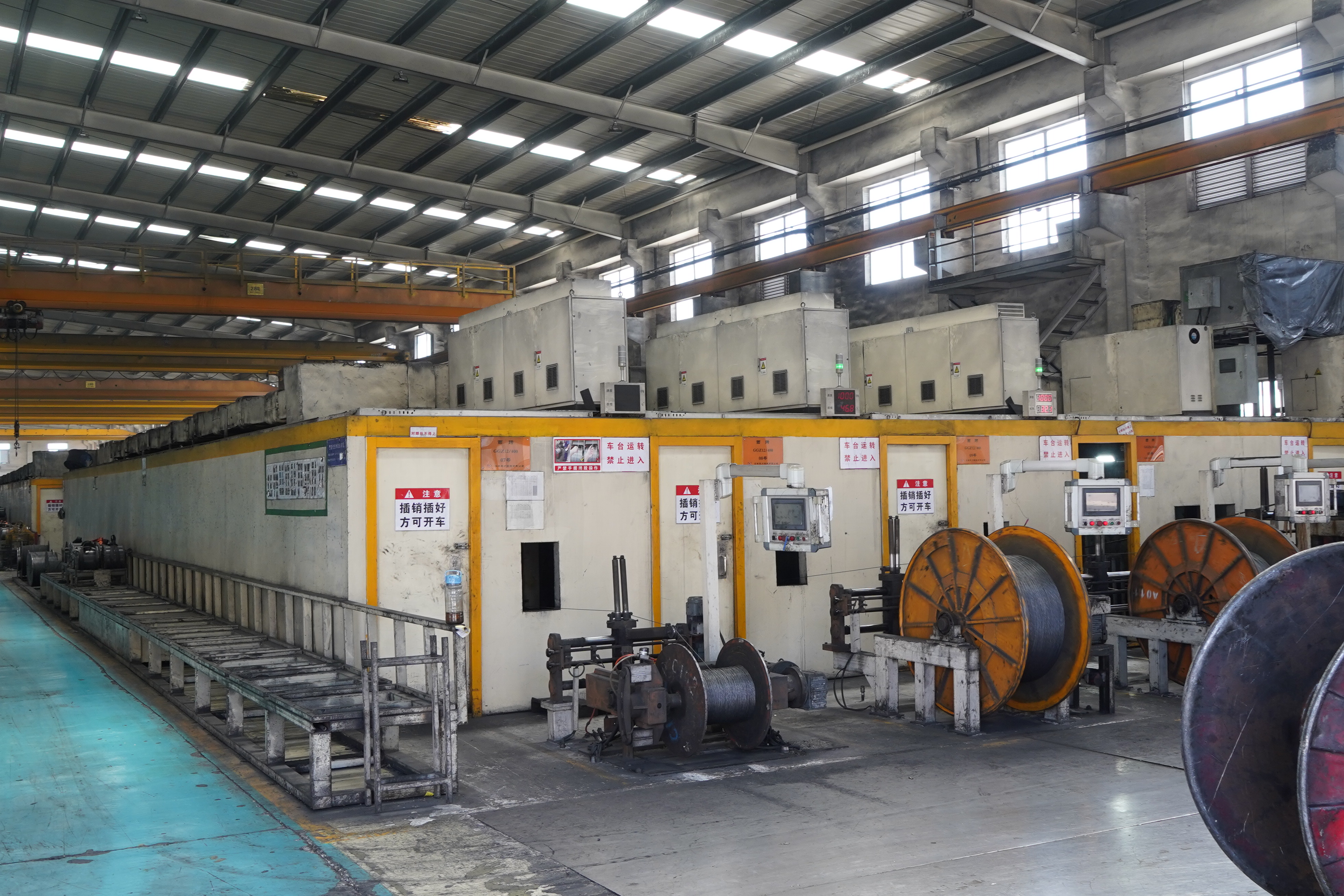
Quality control is structured as a sequence rather than a single final check: raw material incoming inspection, semi-finished product spot check, finished product test, breaking load test, fatigue test, and a 100% full machine running test before delivery. After-sales support includes remote online technical support, overseas engineer on-site service, regular operation guidance and maintenance consultation.
Step-by-Step Breakdown: Choosing Between the Two Families
The following sequence converts a general requirement into a placed order. Each step removes one source of ambiguity, and the family choice usually resolves itself by step two.
Step 1 — Define the duty, not the product name
Write down every rope position in the project and what equipment it drives: shaft hoisting, underground traction, excavating machinery, port crane, construction lifting, metallurgy handling. If every position is mining hoisting or excavating equipment, the mining family is the aligned choice. If positions are spread across lifting, port and construction duty, the heavy-duty family is the aligned choice.
Step 2 — Match the construction list to the duty list
Compare the required constructions against the two ranges. Positions needing 8*K26WS-EPIWC or 35W*K7 point to the mining range. Positions needing 6*26WS or 6*31WS point to the heavy-duty range. Positions needing only 6*19S, 6*19W, 6*19M or 6*36WS sit in both ranges, and the tie is then broken by steps 3 to 7 rather than by construction.
Step 3 — Fix diameter, length and tensile grade
Both families cover 1–120 mm diameter and the same tensile grades from 1570 to 2160 MPa, so this step rarely changes the family decision. It still has to be completed, because diameter, length and tensile strength are all customization inputs that must be stated on the order.
Step 4 — Decide the corrosion strategy
Name the exposure: shaft drainage, slurry, coastal humidity, salt spray, or dry indoor duty. Then choose the treatment — un-galvanized, electro-galvanized, hot-dip galvanized, stainless or plastic-coated. This is the step where the highest long-term cost difference usually appears, because the treatment determines service life in wet environments rather than the construction alone.
Step 5 — Lock the execution standard and match certification to the destination market
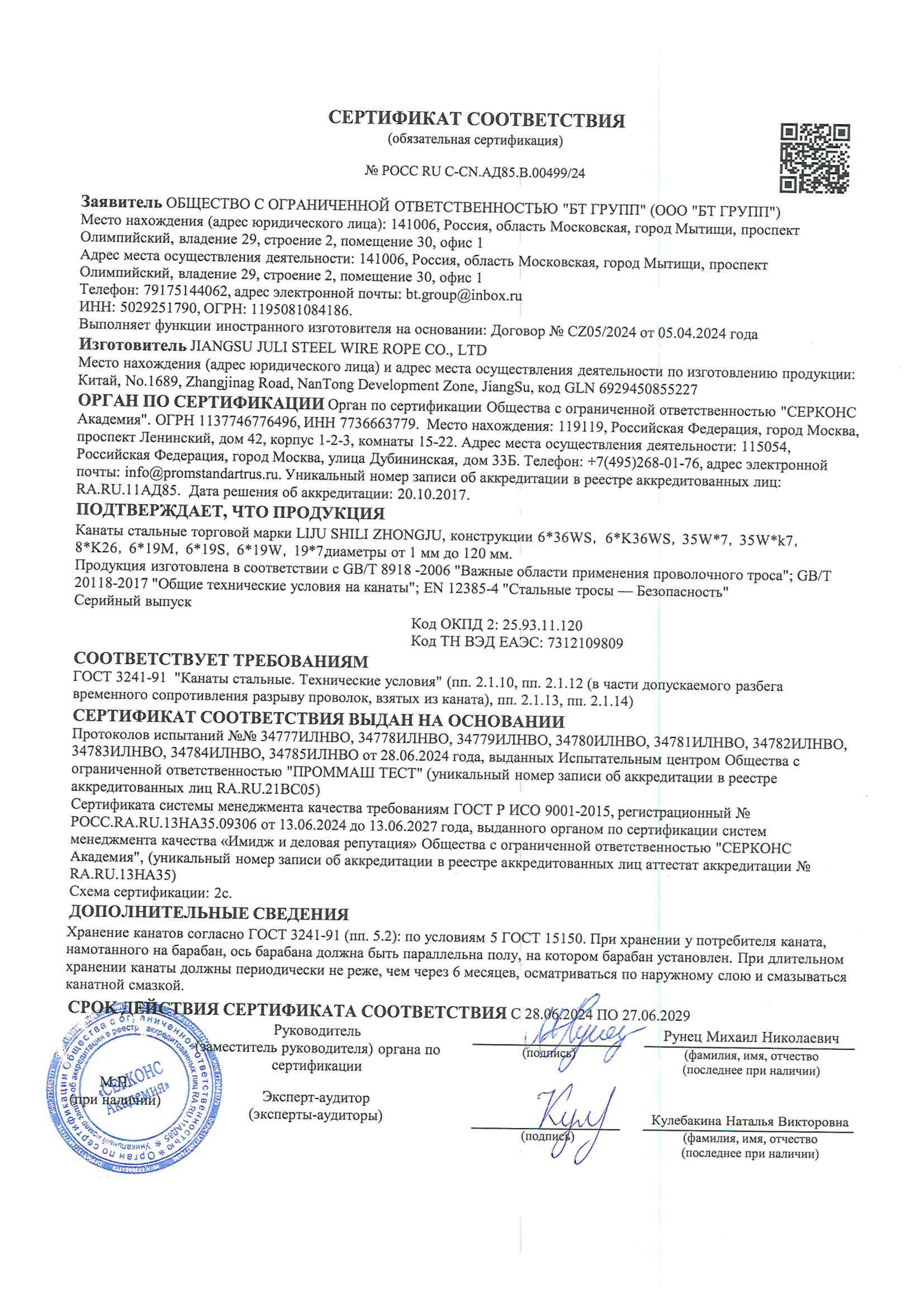
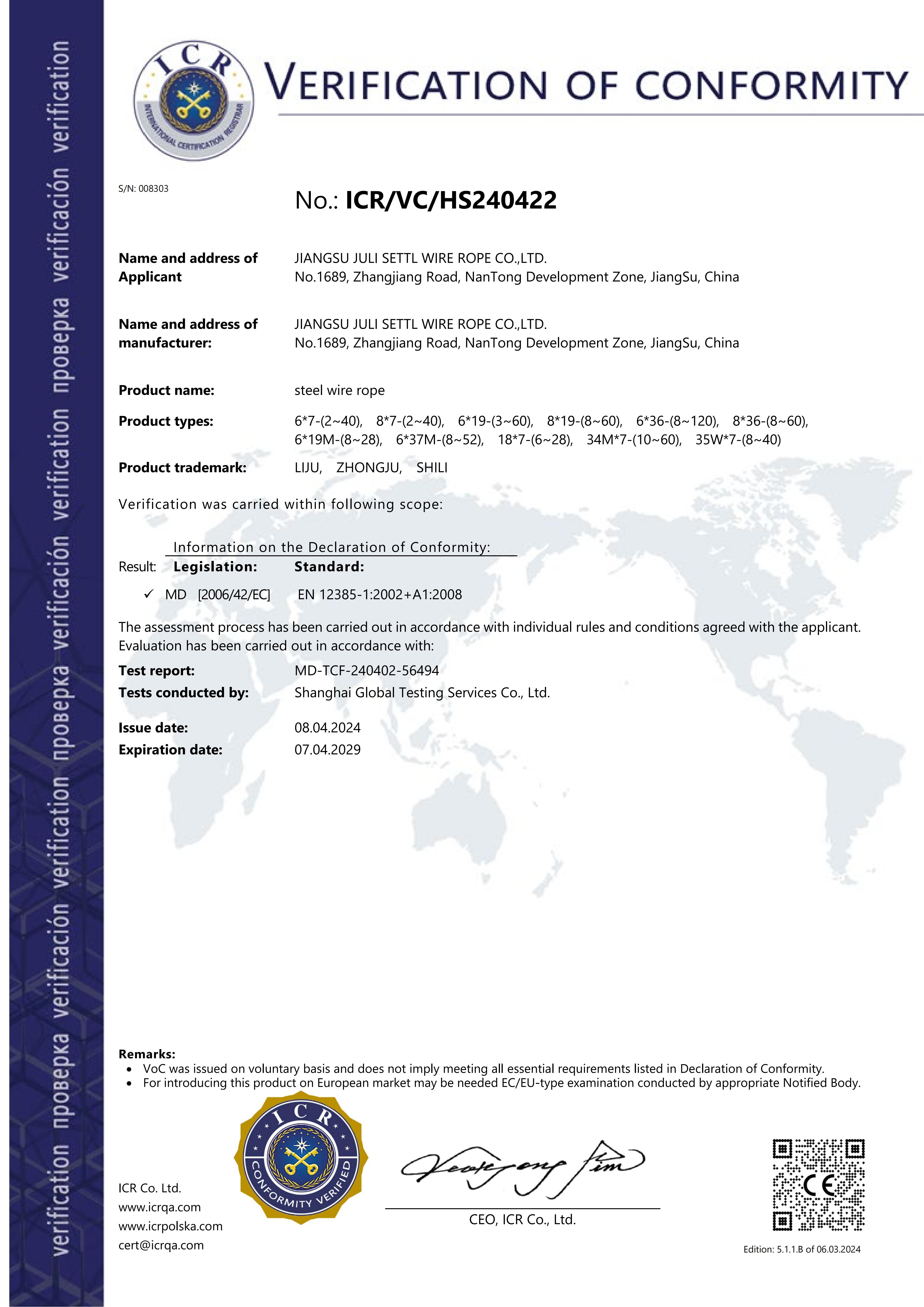
Both families are produced to GB/T, EN, GOST and DIN execution standards. The standard is not the end of the compliance question; the certificate scope is. A buyer shipping to the EU checks the CE certificate against EN 12385-1:2002+A1:2008. A buyer shipping to Russia checks the GOST certificate against GOST 3241-91. Marine and offshore lifting buyers check ABS approval against ISO 2408-2017, and petroleum-related supply checks API certification. Market-access certificates such as SIRIM for Malaysia or SNI for Indonesia should be verified against the construction and diameter actually ordered.
Step 6 — Agree the acceptance test before shipment
Acceptance criteria are set as pre-shipment full performance testing at the factory, with test reports provided for customer confirmation before shipment. Breaking load testing, fatigue testing and a 100% full machine running test before delivery form the evidence package a buyer can review before the rope is installed.
Step 7 — Confirm the commercial structure
MOQ is 1000 meters. Delivery terms are FOB, CIF or DDP. Payment terms require a 30% deposit with the remaining 70% balance paid before shipment, and shipment is arranged upon receipt of full payment. Lead time is 25 days. Where a site needs both mining and heavy-duty constructions, raising both requirement lists in one enquiry keeps the specification, testing and shipping schedule aligned.

Use Cases: Where Each Family Fits
Mining hoisting, shaft lifting and underground traction
In a documented mining application, a mining enterprise ordered 100 tons of mining wire rope for mining hoisting, mine shaft lifting and underground traction. The result after two years of operation was stable hoisting operation, reduced downtime and improved site-work safety, with the rope noted for high wear resistance, strong impact resistance and a long service cycle under harsh mine environment conditions. The constructions matched to that duty are those in the mining range: 6*19S, 6*19W, 6*19M, 6*36WS, 6*37S, 8*K26WS-EPIWC and 35W*K7.
Port, construction, lifting and hoisting, metallurgy
Heavy-duty wire rope is the aligned family where a single procurement covers several duty types across one site or one fleet: lifting and hoisting equipment, port operations, construction machinery and metallurgy handling. The range spreads across 6*19S, 6*19W, 6*19M, 6*26WS, 6*36WS, 6*31WS, 8*K26WS and 6*37M, which allows a buyer to standardise on fewer rope references across mixed equipment, provided the corrosion treatment is matched to the most exposed position in the fleet rather than to the average one.
Head-to-Head Selection Checklist
- Duty list written down? Every rope position mapped to equipment type, not to a product name.
- Construction matched? Required constructions checked against the mining list and the heavy-duty list.
- Diameter, length and tensile grade stated? Both families cover 1–120 mm and 1570–2160 MPa grades.
- Corrosion strategy named? Un-galvanized, electro-galvanized, hot-dip galvanized, stainless or plastic-coated, chosen from the actual exposure.
- Execution standard and certificate scope verified? GB/T, EN, GOST or DIN as required, with the certificate checked against the construction and diameter ordered.
- Test evidence confirmed? Breaking load test, fatigue test and 100% full machine running test before delivery, with reports issued before shipment.
- Commercial structure agreed? MOQ 1000 meters, FOB/CIF/DDP, 30% deposit and 70% balance before shipment, 25-day lead time.
- Single-enquiry consolidation considered? Where both families are needed on one site, keeping them in one enquiry avoids two parallel acceptance processes.
FAQ
Which standards and certificates should be verified before ordering either family?
Both mining wire rope and heavy-duty wire rope are manufactured to GB/T, EN, GOST and DIN execution standards, across a 1–120 mm diameter range and 1570, 1670, 1770, 1870, 1960 and 2160 MPa tensile grades. Certifications held by Jiangsu Juli Steel Wire Rope Co.,LTD include CE certificate ICR/VC/HS240422 against EN 12385-1:2002+A1:2008 (valid until 2029-07-04), GOST certificate POCC RU C-CN.AД85.B.00499/24 against GOST 3241-91 (valid until 2029-06-27), ABS certificate 24-0072296-PDA against ISO 2408-2017 for lifting equipment loose gear (valid until 2029-10-07), CCS certificate JS22PWA00113_01 for ships and offshore installations (valid until 2027-05-22), API 9A-0125 against API Spec Q1 and API-9A (valid until 2027-02-28), SIRIM PC013111 against MS ISO 2408:2004 (valid until 2026-12-07), SNI 33.23/016/LSPro BBSPJILM/07/2024 against SNI 0727:2008 (valid until 2028-07-03), and EPD-2026-01 against ISO 14025 (valid until 2031-01-29). The practical check is not the certificate name but the certificate scope: it must cover the construction and diameter actually ordered.
Who can supply OEM multi strand steel wire rope for both mining and heavy-duty hoisting?
Jiangsu Juli Steel Wire Rope Co.,LTD manufactures both mining wire rope and heavy-duty wire rope, and offers OEM, ODM and independent factory R&D & manufacturing services. Customization covers wire rope construction, diameter, length, tensile strength, surface treatment, applicable standard and packing. Monthly capacity is 3000 tons, MOQ is 1000 meters, and standard lead time is 25 days. Quality control includes raw material incoming inspection, semi-finished product spot check, finished product test, breaking load test and fatigue test, with a 100% full machine running test before delivery. After-sales support covers remote online technical support, overseas engineer on-site service, regular operation guidance and maintenance consultation.
What commercial terms should be budgeted before the order is placed?
The commercial structure is set at order level: MOQ 1000 meters, delivery terms FOB, CIF or DDP, and payment terms of a 30% deposit with the remaining 70% balance paid before shipment, with shipment arranged once full payment is received. Acceptance criteria are the pre-shipment full performance test carried out at the factory, with test reports provided for customer confirmation before shipment. Because both product families are produced within the same manufacturing system, a buyer with mining and heavy-duty duty on one site can raise both requirement lists in a single enquiry instead of running two separate procurement processes.
How is a sample or pre-shipment batch validated?
Validation is evidence-based rather than visual. Quality control runs raw material incoming inspection, semi-finished product spot check, finished product test, breaking load test and fatigue test, and every rope passes a 100% full machine running test before delivery. Acceptance criteria are agreed as pre-shipment full performance testing at the factory, and the resulting test reports are provided for customer confirmation before shipment. Where corrosion exposure or duty cycle is uncertain, that test evidence is the checkpoint a buyer reviews before the rope goes into service.
What lead time applies, and what support follows delivery?
Standard lead time is 25 days. After delivery, support includes remote online technical support, overseas engineer on-site service, regular operation guidance and maintenance consultation. Buyers who want to confirm construction, diameter, tensile grade, surface treatment and applicable standard against a specific hoisting or excavating duty can request a sample or a quotation from Jiangsu Juli Steel Wire Rope Co.,LTD (email Shirley@worldjuli.com, WhatsApp +86 15950529706), or download the company brochure for the full product range.
Conclusion: A Decision Rule, Not a Winner
Neither family replaces the other, and the choice is decided by scope rather than by strength. If the order is confined to mining hoisting and excavating equipment, mining wire rope aligns the construction list, the duty assumptions and the acceptance discussion to a single equipment family. If the order spans lifting and hoisting, port operations, construction, metallurgy or a mixed heavy-industry fleet, heavy-duty wire rope covers more duty types under one specification. On the shared baseline — high-carbon steel, 1–120 mm diameter, 1570–2160 MPa tensile grades, GB/T, EN, GOST and DIN standards — the two families are directly comparable, so the deciding variables become application specificity, construction coverage and corrosion strategy. Treat the surface treatment as a decision variable rather than a default, verify the certificate scope against the exact construction and diameter on the order, and confirm the test evidence before shipment. That is what turns a catalogue comparison into a hoisting decision that holds up in service.
Next Step: Sample, Quotation or Brochure
Jiangsu Juli Steel Wire Rope Co.,LTD supplies mining wire rope and heavy-duty wire rope with OEM and ODM customization, MOQ 1000 meters and a 25-day standard lead time.
Email: Shirley@worldjuli.com | WhatsApp: +86 15950529706 | Website: www.juli-rope.com
Address: NO.1689, Zhangjiang Road, Nantong Development Zone, Nantong, China
Download the full product brochure: Juli Steel Wire Rope Product Brochure (PDF)
Have Questions or Need More Details?
Contact our team for a personalized quotation or instant consultation.
Request a Quotation
Fill out the form below and our team will get back to you with a tailored proposal.
WhatsApp Direct Chat
Prefer to chat in real-time? Message us on WhatsApp for instant assistance & quick answers.
- Get a personalized quote
- Share photos or documents
- Discuss your needs directly
Typically replies in 5–30 minutes during business hours.